Get Full Government Meeting Transcripts, Videos, & Alerts Forever!
Get email alerts on the Large Loads And Cost Allocation topic
No spam. Unsubscribe anytime.
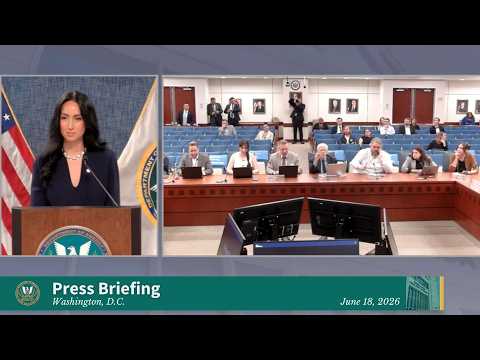
FERC chair: commission issued six orders to speed interconnection and limit cost‑shifting for large energy loads
Summary
At a press briefing the FERC chair said the commission issued six orders setting tight deadlines for RTO/ISO responses, clarifying cost‑allocation expectations for large loads and preserving existing bilateral deals; reporters pressed on litigation risk, environmental review and state roles (date not specified).
The chair of the Federal Energy Regulatory Commission said the agency issued six orders intended to accelerate interconnection for large energy loads, tighten timelines for responses from regional transmission organizations and clarify how costs should be allocated so consumers are protected.
"Waiting is not an option. Millions of Americans are counting on FERC to deliver, and we're not going to let them down," the chair said, introducing the issuances as "bold" and "transformative" and stressing the orders were written "with litigation in mind." The chair added the commission tailored requirements to regional conditions and would hold markets to ambitious deadlines.
Why it matters: the orders address how data centers and other very large electricity customers — often called hyperscalers — are integrated into the bulk electric grid and who pays for transmission and upgrade costs. The chair said the commission will require greater transparency and granularity in cost reporting so states and regulators can evaluate whether costs are shifting unfairly onto retail customers.
Reporters pressed the chair on several specifics. James Downey of RTO Insider asked whether the orders were deliberately drafted to avoid litigation; the chair replied that each order was carefully reasoned and supported by precedent to reduce the likelihood of successful legal challenges.
On timelines, a reporter identified as Sider asked when binding cost‑allocation decisions would be final. The chair declined to give a single nationwide completion date, saying markets are in different places and that some regions — he cited SPP as "probably over 90% of the way there" — will move faster than others. He said the approach adopted uses regional pathways and that staff will walk market participants through the orders' schedules.
On cost shifting, the chair described the issue as technical and market‑specific but said recent approvals have required large loads to bear the costs of necessary upgrades to receive service. "The large loads that require service have agreed to be on the hook for all of the costs associated with the upgrades that are necessary for them to get service," he said, and directed staff to provide more detailed guidance to markets.
Environmental review questions centered on the C2 docket and cumulative‑impacts analysis. Asked whether the commission would stop considering cumulative impacts broadly, the chair said FERC will "uphold the law as a first principle" and respond to issues raised in individual dockets under the Administrative Procedure Act. He said the commission will not perform unnecessary cumulative analyses when the record does not require them, but that information about nearby activities will be considered when it helps contextualize a project's reasonably foreseeable effects.
Asked whether allowing large customers to "bring their own generation" could create reliability problems, the chair stressed that FERC will not approve measures that threaten reliability and that coordination with the North American Electric Reliability Corporation is a critical part of the work.
The chair also said the orders will grandfather existing bilateral commercial agreements that are underway or finalized so tariff reforms will not upset those deals. He emphasized states should participate actively in the dockets and provide feedback on the increased cost transparency the commission is requiring.
What the orders do not show in this briefing: the transcript records the chair describing the issuance of the orders and the policy intent, but it does not include a formal recorded vote or the full text of the orders. Staff was identified as available to walk reporters and market participants through the orders and the associated dockets.
Next steps: the chair said staff will provide more detailed materials and that the commission will expect timely responses from markets; states and stakeholders are invited to file comments and rehearing requests where appropriate. The session closed with thanks to reporters and a note that staff would follow up with documents for those remaining online and in the room.