Get Full Government Meeting Transcripts, Videos, & Alerts Forever!
Get email alerts on the School Budget topic
No spam. Unsubscribe anytime.
Bristol budget committee vets FY27 school budget as debt service, special‑ed costs and capital overruns draw scrutiny
Summary
Budget committee members probed a FY27 draft that shows higher per‑pupil costs driven largely by debt service for recent construction, visible increases in special‑education staffing costs, and supplemental capital work (generator, south wall) performed during renovation. Staff said FY23 is the last completed audit and FY24 audits are just starting.
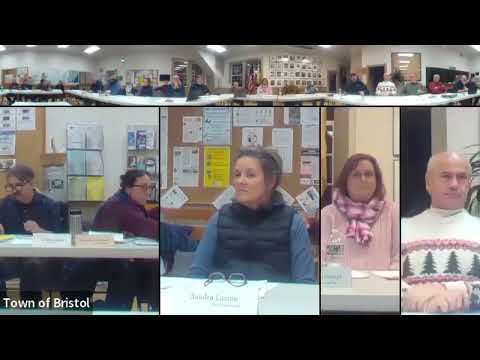
Bristol — Members of the Bristol School budget committee spent their meeting reviewing the FY27 draft school budget and pressing staff for clearer line‑item detail after a capital addition/renovation exceeded its original estimate.
Pat Johnson, who introduced herself as a school board member and a small business owner, told the committee the purpose of the session was to inform members' recommendation on the FY27 budget while urging a focused review of finance questions. "We are not here to pick apart the work of the committees we have appointed or the administrators we have hired," she said, asking the committee to limit the discussion to budget issues rather than re‑litigating prior governance decisions.
Staff summarized the renovation accounting: the original project budget was presented at about $6.42 million and reported actual spending of roughly $7.2 million, with several supplemental items executed during the construction period — including a generator, security upgrades and kitchen equipment. Staff said those supplemental items were completed while crews were on site and that bond proceeds, capital reserve withdrawals and several grants were used to cover portions of the total.
Committee members sought clarity on capital reserve accounting and reimbursements: staff cited about $143,000 expended from the capital reserve and an approximate remaining balance near $190,000, but said final numbers depend on negotiating the contractor's final invoices and accruing interest on bond proceeds.
Audit timing also drew questions. In response to a committee query on when the books had last been officially audited, a staff speaker said the FY23 audit is the most recent fully completed audit for the school and that FY24 audits were only at an early stage; staff said they were discussing hiring a pre‑auditor to organize records and speed completion of the external audits, with a rough estimate that a pre‑audit could cost a fraction of a full audit (staff estimated a pre‑audit might be roughly one‑third of a full audit fee).
Per‑pupil costs and drivers of inflation in the budget were central topics. Committee members cited analyses showing Bristol's per‑pupil figure could range from roughly $30,000 to $37,000 depending on whether secondary tuition and regional allocations are included. Staff and members agreed that debt service tied to the new building is a large component of the elevated per‑pupil figure; other drivers include multi‑year teacher contract increases, rising health‑insurance costs and higher transportation contract rates.
Special education and related staffing lines were highlighted as a major source of year‑to‑year increases. Committee members noted occupational therapy (OT) and related services moved from being embedded inside regional contracts to being recorded on local payrolls, which made those costs more visible. Staff explained that the district now shows the direct staffing and payroll costs for those services; as a result, OT line items increased in visibility even if some services were previously budgeted in regional or contract accounts.
Members asked staff to assemble clearer rollups for the next meeting: an itemized list of remaining building work (for example, south wall repairs and the generator installation), a reconciled capital reserve ledger showing amounts already expended versus planned reimbursements, and a two‑ to three‑page summary that ties projected expenditures to the FY27 revenue assumptions. The committee agreed those materials would help decide what should be funded from bond interest, capital reserve or the general fund.
A public commenter, Marley Bennett, identified herself as a parent and early‑education nonprofit worker and urged continued local access to early OT and speech services. "The earlier children receive services, the more those interventions can offset costs later and build lasting relationships with providers in our community," she said.
Procedurally, the committee approved the prior meeting's minutes and adjourned after asking staff to circulate updated budget documents in advance of a detailed line‑by‑line review scheduled for February.