Get Full Government Meeting Transcripts, Videos, & Alerts Forever!
Get email alerts on the Prep Streamline Amendments topic
No spam. Unsubscribe anytime.
FPPC previews changes to PREP and Streamline rules, adds executive director review for discretionary cases
Summary
Commission counsel presented proposed pre-notice amendments to clarify eligibility, discretion, and documentation for the PREP (education) and Streamline enforcement programs, including giving the executive director a reviewing role when staff seeks to include borderline cases.
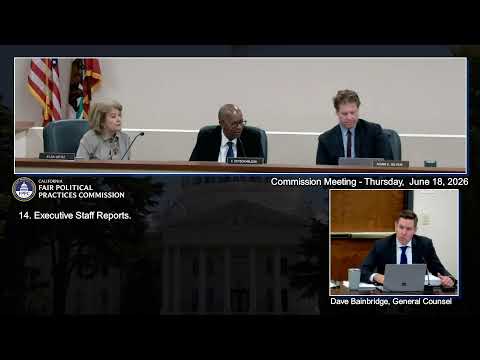
At its June 18 meeting the Fair Political Practices Commission discussed pre-notice amendments to regulations governing the Political Reform Education Program (PREP) and the Streamline program, which staff said are intended to simplify and clarify procedures for resolving low-level campaign law violations.
Commission Counsel Simon Russell said the PREP and Streamline programs are designed to "efficiently resolve low-level violations of the act so that staff resources are freed up for more serious and more complex cases." He described five primary procedural changes the draft would make: clarify which eligibility criteria are mandatory versus advisory; define the scope of discretion for borderline cases; specify when respondents must "come into compliance" before entering PREP or Streamline; set the minimum content required in a Streamline stipulation; and clarify the relationship between warning letters and Streamline/PREP.
A notable proposal would require the Executive Director to approve cases where staff would use discretion to include an otherwise excluded matter in Streamline. Russell summarized the change: "Unless an exclusion applies, the Executive Director of the commission, after receipt of a recommendation by the chief of enforcement, will determine the appropriate form and amount of penalty" when discretion is used.
Commissioners asked how the commission and the public would be notified when discretion is used and whether stipulations should explicitly flag such cases. Chief of Enforcement Kendall Boonbrake said his office's practice is already to list proposed Streamline settlements in a monthly enforcement report, and staff suggested the regulation could be amended to require a notation where discretion is used.
Commissioner Ortiz cautioned that vague terms such as "other circumstances" that allow waivers of compliance could be stretched and asked staff to provide examples; Russell and Boonbrake said they would return with sample scenarios at adoption. Enforcement staff said roughly three-quarters of enforcement resolutions were handled through Streamline last year and that the proposed changes are intended to preserve that efficiency while improving clarity and oversight.
Public commenter Rory McNear urged the commission to ensure enforcement obtains and preserves server records and original filings when exclusions are based on altered or non-original documents. Staff responded that they would refine the draft as needed and include additional information about dispute-resolution mechanics at adoption, currently expected in August.
If adopted, the changes would alter how low-level campaign violations are processed and add a formal safeguard when staff uses discretion to depart from strict eligibility criteria.