Get Full Government Meeting Transcripts, Videos, & Alerts Forever!
Get email alerts on the Community Access Area 17 topic
No spam. Unsubscribe anytime.
PURA hearing probes Cox operations, budgets and claims as Nutmeg seeks to assume Area 17 access duties
Summary
At a PURA evidentiary hearing, Cox defended its management of Area 17 public-access operations — including the Meriden studio — describing staffing, budgeting practices and community outreach while Nutmeg and intervenors pressed over travel burdens, fee allocations and whether local advisory letters reflect producer views.
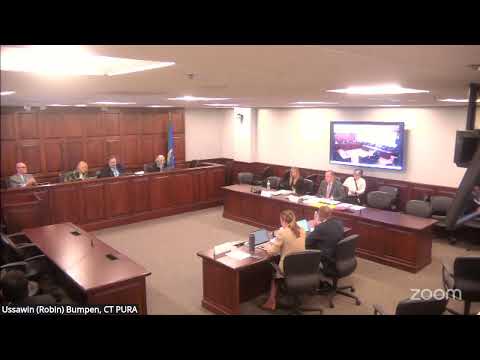
Commissioner Holly Cheeseman presided over a multi-party evidentiary hearing on petitions that would transfer community access operations in parts of Connecticut to Nutmeg Public Access Television, with cross-examination of Cox witnesses focusing on the company’s role in Area 17, budget treatment and studio operations.
Cox’s witness said Cox views its role in Area 17 as “part of its franchise obligations,” and described the company as operating community access studios to provide area residents and producers “a platform that will provide them with the opportunity to meaningfully communicate with members of their community.” Pascalin Poku of the Office of Consumer Counsel led the cross-examination into how Cox runs the Meriden studio and how it counts programming in annual CAP reports.
Cox told the panel it does not control the content on towns’ E and G government/education channels — it provides carriage and a technical connection — and that those channels’ programming is driven by the towns or ENG operators. For the public access (P) channel, Cox said the company both operates studios and accepts uploaded content from residents and sponsors.
On finances, Cox acknowledged that the Meriden studio ran at a modest shortfall last year — roughly $7,000 — and said PEG operations nationally are managed through its public affairs budget rather than a separate rainy-day fund dedicated solely to PEG. Cox explained that some Connecticut studio budgets are presented together for internal reporting, but insisted subscriber funds are used to operate local PEG channels and that shortfalls have been covered from company budgets where needed.
Nutmeg attorneys pressed Cox on whether transferring operating responsibility to Nutmeg would burden local producers by requiring travel to Nutmeg’s Farmington studios. Cox said it allows producers to use other nearby Cox studios and disputed an assertion that moving to Farmington would impose an unreasonable burden; Nutmeg countered that even modest increases in travel are material to local volunteers and producers.
Counsel also questioned the provenance of support letters in the docket. Nutmeg noted the mayor of Cheshire, Peter Talbett, a former Cox government-affairs manager, had written in support of Cox; Nutmeg argued the record did not show producers or the broader public had been consulted before the advisory council’s opposition letter was issued. Cox’s witnesses said they could not speak to every external letter’s preparation but confirmed the cable advisory council’s chairman stated opposition in a submitted letter.
On interconnection and fees, Cox said it receives a lump-sum PEG remittance from some other video providers (Frontier) and, without Frontier’s breakdown, Cox cannot conclusively allocate those sums to specific franchise areas. Cox reported the Meriden PEG fee was $9.50 in 2025 and adjusted to $9.81 for 2026 (about $0.82 per month), and that PEG-related legal fees from this docket would not be charged back to PEG budgets.
What happens next: Cox agreed to provide supplemental filings the authority requested — including clarifications of certain interrogatory responses and forward-looking PEG expense estimates — before the scheduled late-filed-exhibit hearing.