Get Full Government Meeting Transcripts, Videos, & Alerts Forever!
Get email alerts on the Energy Performance Contract topic
No spam. Unsubscribe anytime.
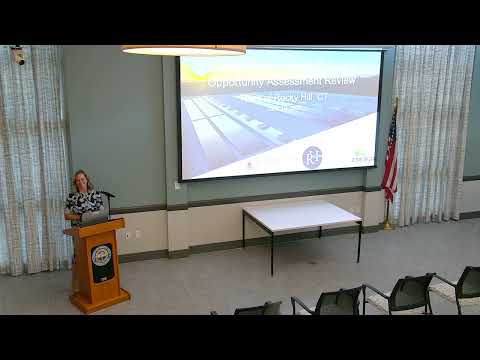
Eneria owner Kendra Mcquilton pitches self‑funding energy upgrades for Rocky Hill schools
Summary
At a joint Board of Education and Town Council meeting, Eneria owner Kendra Mcquilton proposed using an energy performance contract (EPC) to fund school and municipal energy upgrades without upfront taxpayer costs, estimating about $182,000 in annual savings from efficiency (a $3.3M self‑funding project) and up to roughly $500,000 per year if solar is included.
Kendra Mcquilton, owner of Eneria, told a joint meeting of the Rocky Hill Board of Education and Town Council that an energy performance contract (EPC) could allow the district and town to complete capital upgrades without upfront taxpayer spending. "It does not require any upfront costs," Mcquilton said, describing EPCs as a state‑authorized alternative funding mechanism that repays project costs from guaranteed energy savings.
Mcquilton said Eneria — which the Connecticut Conference of Municipalities has listed as a preferred vendor — helps school districts and towns run an ESCO RFP, select an energy services company (ESCO), oversee construction, and verify savings. Under the model she described, the ESCO designs and builds projects, trains staff, and guarantees the savings; if savings fall short, the ESCO must reimburse the difference, she said.
Using district utility data and EPA benchmarking, Eneria presented conservative, building‑by‑building estimates. Mcquilton summarized that the district could expect about a 22% reduction in energy use from efficiency measures alone, which she translated to roughly $182,000 in annual savings and a conservative self‑funding project size near $3.3 million. "When you calculate the solar in, we're estimating the percent reduction at about 62%," she said, adding that solar and renewables could lift savings to about $500,000 per year and support a larger, roughly $9 million package.
Mcquilton described typical EPC measures — LED lighting and controls, HVAC and temperature controls, and building envelope work such as doors and windows — and explained the financing mechanics: projects are commonly repaid over a long lease term, and Eneria said a municipal tax‑exempt lease is a typical option. "Typically, this is financed through a tax exempt municipal lease mechanism," a participant identified in the discussion as Scott said when describing repayment options.
Eneria emphasized that projects must be self‑funding under state rules (the presenter said the aggregate package must pay for itself within 20 years) and described the RFP process: Eneria will develop the RFP with district priorities, ESCOs will submit site‑specific audits and proposals, and the winning ESCO will be responsible for delivering and guaranteeing performance. Mcquilton proposed issuing the RFP in July with proposals expected in August.
On questions from board and council members, Eneria addressed roof life for solar siting (the firm said it would avoid installing solar on roofs with less than about 15 years of useful life), options for schools that could close (limiting measures to quick‑payback items), and how measure mixes pair quick‑payback lighting controls with longer‑payback boilers or windows to meet statutory payback limits. The presenters noted that some district buildings already have efficient boilers and that final scope depends on ESCO site audits.
Mcquilton said Eneria offers an initial EPC opportunity assessment at no cost and that the firm is paid from project savings; she also said Eneria would charge a $20,000 fee if the district runs a full RFP and then elects not to move forward, a fee framed as covering ESCO and firm effort and discouraging unnecessary RFPs. Mcquilton described a mostly positive track record for similar projects and acknowledged one remedied case in which an ESCO corrected an engineering error at its own expense.
Next steps reported at the meeting: consider formally retaining Eneria to develop and issue the ESCO RFP; if Eneria is retained, the firm expects to issue the RFP in July and receive proposals in August for review. No formal vote or binding commitment to proceed was recorded at the meeting.
What happens next: the board and council can vote separately to authorize staff to retain Eneria or to proceed with an RFP; if retained, the RFP responses and ESCO proposals would be the basis for any later decision about specific projects and financing.