Get Full Government Meeting Transcripts, Videos, & Alerts Forever!
Get email alerts on the Zoning Data Centers topic
No spam. Unsubscribe anytime.
Jackson County reviews draft data-center ordinance as residents raise water, noise and utility concerns
Summary
Jackson County zoning commissioners and supervisors reviewed a draft high-density computing facilities ordinance and heard widespread public comment asking for stronger setbacks, clearer enforcement and answers about water and electrical infrastructure; no adoption vote was taken and a moratorium remains in place through August 2026.
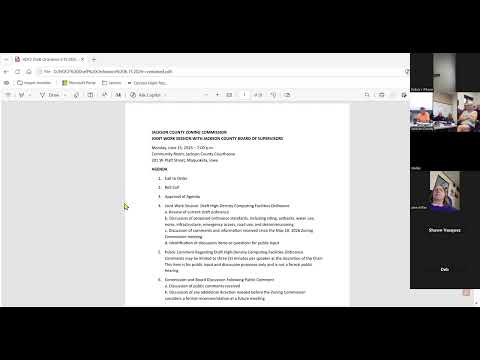
Jackson County zoning commissioners and members of the Board of Supervisors held a joint work session on June 15 to review a draft ordinance that would regulate high-density computing facilities (data centers) in unincorporated parts of the county. The gathering included a staff presentation of proposed standards and an extended public-comment period in which residents raised concerns about setbacks, water and electricity use, noise and enforcement.
Becca, a member of the county zoning staff, framed the session as a review of a draft ordinance still under revision and not tied to any specific proposed site. She reminded attendees the draft was developed after earlier public input and multiple noticed meetings, and stressed the purpose of the work session was to solicit additional direction before a formal recommendation and future readings by the Board of Supervisors.
Residents at the microphone urged stronger protections. "Jackson County has been proactive — they have done their due diligence in this ordinance," said Ronda Rowan, a Springville resident, who thanked staff for outreach but asked for larger setbacks from homes. Several speakers asked that setbacks be measured from property lines and suggested a 1,000-foot or larger buffer from residences to reduce the chance a homeowner later builds nearer a facility and finds it incompatible with their property.
Concerns about utilities were prominent. Commissioners noted the draft requires applicants to submit a proposed maximum electrical service load, but several asked how the county can prevent a data center from consuming the bulk of local utility capacity and thereby limiting future economic growth. One commissioner proposed that the county consider reserving utility capacity so a single user does not consume close to 100% of local distribution capacity; staff replied that local land-use rules cannot directly require private utilities to hold reserve capacity, though the zoning standards can require disclosure of proposed loads to inform local review.
Online commenter Nick Darrow (South Fork) raised enforcement examples from elsewhere, saying companies have drilled unpermitted wells and, in one cited instance, allegedly "stolen roughly 30 million gallons of water," with limited penalties. "What are the repercussions if they break the rules?" he asked; staff acknowledged the concern and said penalties in the draft will be reviewed and tied into the county's broader enforcement framework.
The draft contains specific provisions that were discussed in the meeting: a 500-foot buffer from property lines, a 1,000-foot buffer from occupied structures, a requirement that facility owners provide baseline and complaint-triggered vibration testing, and language that the owner/operator shall pay testing costs. Commissioners debated whether the draft’s vibration quiet-hours threshold (which distinguishes daytime and nighttime beginning at 10 p.m. in the current draft) should be moved earlier to better protect families. Staff said many numbers were modeled on prior county ordinances and that adjustments should be justified with evidence to avoid arbitrary limits that could be vulnerable to legal challenge.
Cooling-system types also shaped the discussion. Staff noted not all data centers use water-based cooling; some use air-cooled or closed-loop systems. Air-cooled systems can be noisier and prompted several residents to urge stronger noise and vibration controls. Residents also asked practical questions about where e-waste would be disposed of and who would pay for electrical infrastructure upgrades if a site required utility expansion; staff recorded the questions for follow-up and noted that some technical answers may require input from utilities and the county attorney.
Staff confirmed a moratorium on new high-density computing facility applications in unincorporated Jackson County is in place through the end of August 2026 to allow the county time to finalize defensible standards. The county intends to revisit the draft at upcoming meetings in July and August; any ordinance approved by the Board of Supervisors will require three separate readings (three meetings) and at least one public hearing before final adoption.
The meeting closed with a reminder that the draft is a working document and that staff and elected officials welcome written comments and further questions as they refine language on setbacks, penalties, enforcement, testing responsibilities and applicability (for example, distinguishing true high-density computing facilities from small server rooms or ordinary office servers). No final votes on the ordinance occurred during the work session; the moratorium remains in place while the draft is revised.