Get Full Government Meeting Transcripts, Videos, & Alerts Forever!
Get email alerts on the Utilities topic
No spam. Unsubscribe anytime.
Port Orange council approves final-year utility rate increase after debate over affordability
Summary
After public comments about hardship, the City Council approved the fourth-year water and sewer rate increase — the final step of a four-year plan — saying the enterprise fund must cover aging infrastructure. Council voted to approve the staff resolution authorizing the final increase.
Port Orange — The City Council voted to approve the fourth and final rate increase in a four-year plan for the city’s water and sewer utility, concluding a lengthy public discussion that included residents who said the rise would cause hardship for those on fixed incomes.
City Manager Wayne Reed, who led staff’s explanation, said the utility operates as an enterprise fund and is funded solely by user fees, not general tax dollars. “Our water sewer utility is an enterprise fund which means that it’s funded solely through the user fees that are collected. There’s no tax dollars that support this utility,” Reed told the council as he outlined the study behind the phased increases and the capital needs the fees are intended to cover.
The item (resolution 2026‑32) was the fourth step of a multi‑year plan brought to council after a rate study recommended a phased approach rather than a one‑time lump sum increase. Reed and utilities staff described efficiency improvements — an in‑house testing lab, more precise chemical dosing and testing of alternative treatment processes — that have reduced operating costs, while pointing to capital projects including lift‑station rehabs, wastewater force‑main replacement and treatment‑plant upgrades that make steady rate adjustments necessary.
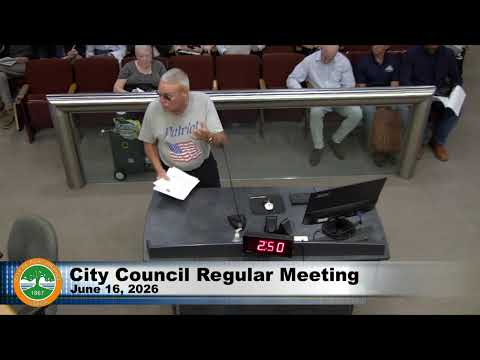
Several residents urged the council to consider the disproportionate effect on retirees and low‑income households. Carolyn Denny, a Countrywalk resident, asked whether the final year increase would be progressive or implemented all at once, noting that a roughly 12.75% figure in the staff materials equated to different dollar impacts depending on usage. Robert Reinhagen, who had spoken earlier about a separate item, reiterated concerns about public access and grant conditions tied to other projects but also voiced opposition to added fiscal burdens.
Council members acknowledged resident concerns and described efforts to phase the increases to minimize shock to households. Councilman Foley and others said the city had the choice, earlier in the process, of a single large increase or smaller, staged increases and that the council deliberately chose the latter to ease the effect on customers. The council also noted state and federal grant and appropriations support that has offset local costs in recent years.
Outcome and next steps: Council approved the resolution to implement the final year of the rate increase. Staff said they will continue to seek grant funds and cost‑saving measures to reduce future rate pressure and will monitor impacts on low‑income households.
Ending: The new rates move forward as part of the adopted plan; the city manager and utility staff will continue to brief council on project timelines, grant applications and any relief programs for vulnerable customers.