Get Full Government Meeting Transcripts, Videos, & Alerts Forever!
Get email alerts on the Climate Resilience topic
No spam. Unsubscribe anytime.
College Place planners review draft mandatory climate element focused on wildfire, heat and water resilience
Summary
At a June 16 workshop the College Place Planning Commission heard consultants present a draft state-mandated climate element for the comprehensive plan, reviewed public-engagement results (block party and survey), and discussed hazard mapping, draft goals and next steps toward a July draft review.
College Place planners on June 16 reviewed a draft climate element that the state requires be added to the city's comprehensive plan when jurisdictions receive state funding.
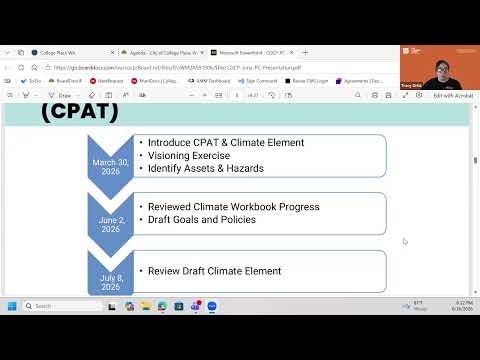
Tracy Ortiz, the project's public-involvement lead with consultant JUB, told the commission the element is meant to "build communitywide climate resiliency" and to help the city qualify for future funding and implementation programs. Ortiz said in-person outreach at a recent College Place block party reached "over 150 folks," and that a short online community survey ran March 30 to June 1 and drew about 20 responses.
The outreach findings, Ortiz said, placed wildfires and related smoke at the top of local concern, followed by drought and water supply, extreme heat and the need for cooling locations, and flooding. "We're seeing the start of wildfire season", Ortiz said as she urged the commission to consider policies that improve community preparedness.
Derek Prattton, senior planner with JUB, walked commissioners through the hazard- and asset-identification process and the state's climate-mapping baseline (the CMRW tool). He said the analysis pairs community assets—such as medical facilities, transportation links, and water systems—with projected hazards and consequences, noting that many hazards are interrelated: "Drought, extreme heat and reduced snowpack can increase wildfire risk and, when extreme precipitation occurs, worsen flooding consequences."
The team presented draft goals A through F. Highlights include: - Goal A: reduce heat risks and improve cooling capacity; use draft policies to pursue grants and plan cooling centers. - Goal B: strengthen drought resilience, improve water conservation and explore an irrigation-reclamation water utility. - Goal C: reduce flood risk through drainage upgrades, green infrastructure, limiting development in high-risk areas and resilient site design. - Goal D: minimize wildfire risk and improve resilience to smoke by promoting fire-wise practices, encouraging fire-resistant materials, coordinating access to clean-air shelters and improving evacuation routes. - Goal E: integrate resilience into capital planning for transportation, water and storm systems. - Goal F: expand public education, improve evacuation and hazard information, and coordinate with regional partners.
Commissioners raised implementation and jurisdictional questions. Several asked that policies explicitly call for identified shelter or cooling locations and for clearer evacuation-route signage. The discussion also noted that some infrastructure affecting city risk, such as certain levees, is outside city control and will require coordination with county, state or federal agencies.
Ortiz said the draft goals are intended as flexible tools: they can help the city apply for funding and be amended (one annual amendment via the municipal docket process). Prattton said the state modeling provides a baseline and that the city's next steps include a July review of the completed draft element with a view to public release later in the year.
The commission did not take formal action on the climate element during the workshop; staff and consultants will return with a completed draft for review and comment.