Get Full Government Meeting Transcripts, Videos, & Alerts Forever!
Get email alerts on the Land Use Procedure topic
No spam. Unsubscribe anytime.
Windham Regional planner outlines rules for running fair local land‑use public hearings
Summary
Matt Bachler, senior planner at the Windham Regional Commission, led a training on quasi‑judicial land‑use hearings covering roles of DRBs, notice and decision timelines (including Act 181’s 120‑day notice requirement), conflicts of interest, and when to continue or close hearings.
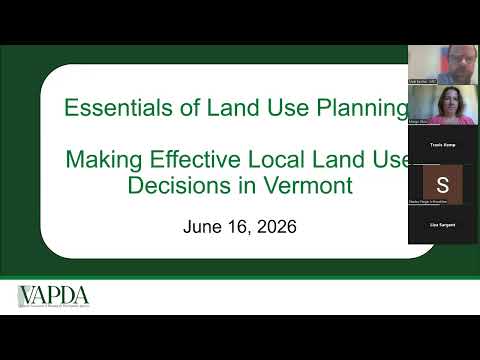
Matt Bachler, senior planner at the Windham Regional Commission, led a recorded Essentials of Land Use Planning workshop for towns in the Windham region on running effective local land‑use hearings.
Bachler told attendees that quasi‑judicial boards — typically development review boards (DRBs) or zoning boards of adjustment (ZBAs) — interpret and apply local rules in a formal hearing process and must protect due process, fairness and a clear record for future review. “The DRB needs to notice a public hearing within 120 days of an application being deemed complete,” he said, citing the Act 181 change enacted in 2024.
Why it matters: clear, well‑documented hearings reduce the risk of costly appeals and help preserve public trust in local government. Bachler said precise findings of fact and consistent rules of procedure make decisions more defensible and easier for applicants and neighbors to understand.
Key guidance from the training included: keep process and substance separate (boards apply bylaws while legislative bodies adopt them); adopt and publish rules of procedure; ensure a quorum (majority of board seats, counting vacancies); consider alternates to avoid delays; and require clear, concise written decisions that list hearings, participants, findings and any conditions attached to approvals.
Bachler recommended the DRB model for many towns because one board can consolidate multiple approvals (site plan, subdivision, conditional use, variances) and appeals, allowing the planning commission to focus on bylaw and plan work. He said the alternative — a planning commission plus a ZBA where the same volunteers serve both roles — can work in small communities but may create inefficiencies if multiple approvals are required across separate bodies.
On deadlines and timing, Bachler repeated two statutory points: notice the public hearing within 120 days after an application is deemed complete (Act 181), and boards must issue a written decision within 45 days of closing the public hearing or, on day 46, the application is considered approved. He also summarized appeal windows: administrative officer decisions have a 15‑day appeal window and board decisions generally must be appealed to the Superior Court Environmental Division within 30 days of the decision.
Bachler cautioned against conflicts of interest and ex parte communications. He advised disclosure and recusal when a member has a financial or personal interest, and to record recusals in the minutes. For site visits he said they are for observation only (no testimony), do not require a quorum, and must be noted in meeting minutes.
Attendees asked practical questions in a Q&A. A participant, Stanley, asked whether an absent stakeholder could be represented by another person or written testimony; Bachler said written comments can be included in the record but that continuances are appropriate when a critical participant (for example, the applicant or a key expert) cannot attend. Kathy asked whether it made sense to convert to a DRB when the same people currently serve on planning commission and a ZBA; Bachler said a DRB can be more efficient but that small towns where the system works have no urgent need to change. Travis, identifying himself as “Travis with Rockingham,” asked whether all 20 petition signers must attend to obtain interested‑person standing; Bachler said the petition/standing rules can be complex and suggested consulting the Vermont League of Cities and Towns (VLCT) for a definitive answer.
Bachler closed by saying the WRC will post slides and a recording on its website and that WRC staff can provide non‑legal technical help; for legal questions he directed attendees to VLCT or their town attorney. The session emphasized procedural clarity, documented findings and consistent treatment of applicants and the public as the best defenses against appeals and erosion of public trust.
The Windham Regional Commission recording and slides will be available on the WRC website; attendees were urged to consult VLCT for statute interpretation and appeal‑standing questions.