Get Full Government Meeting Transcripts, Videos, & Alerts Forever!
Get email alerts on the Home Rule topic
No spam. Unsubscribe anytime.
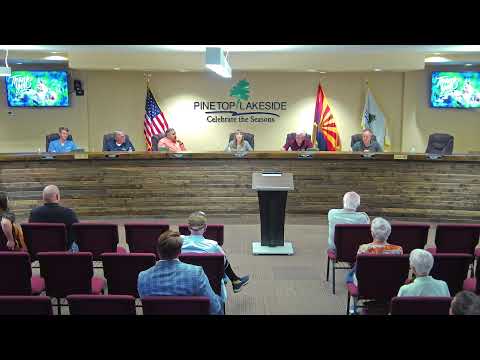
Pinetop-Lakeside council votes unanimously to place ‘home rule’ expenditure-limit question on Nov. 3 ballot
Summary
The town council unanimously approved Resolution No. 26-1821 to submit an alternative expenditure limitation (home rule) to voters on Nov. 3, 2026, after a staff presentation explaining home rule’s effect on local budgeting and a public hearing with no speakers.
The Pinetop-Lakeside Town Council voted unanimously to place an alternative expenditure-limitation measure — commonly called "home rule" — on the Nov. 3, 2026 general-election ballot. Councilor Heisler moved to approve Resolution No. 26-1821 and the motion was seconded and carried without opposition.
Town Manager Christie gave a detailed public presentation before the vote explaining that home rule would allow the town to set its own expenditure limitation instead of operating under the state-imposed formula. Christie emphasized that, as presented to the council, home rule “does not create a new tax,” “does not increase property taxes,” and “does not authorize additional debt,” and instead provides local flexibility to set expenditure limits that better reflect local revenues and the rising costs of municipal services. The staff presentation noted examples of costs that have increased faster than the state formula, including public safety, roads, and employee benefits, and reported the state-imposed expenditure limitation figure shown in the presentation for FY2026–27 as approximately $7.47 million for the town (as presented to council).
No members of the public addressed the council during the home-rule hearing. After closing the public hearing, the council recessed into a special session to consider the formal action. Councilor Heisler made the motion to call the question for the November ballot; the motion was seconded and approved unanimously.
Staff said the town has posted an educational video on the town website and Facebook page and encouraged residents to contact town hall with questions. If approved by voters in November, the alternative expenditure limitation would change the local rule governing how much of the town’s revenue the council may authorize the town to spend each year; any subsequent annual budgets would continue to be adopted through the council’s public process.
The council’s resolution and the staff presentation were explicit that the ballot question concerns expenditure authority only and does not itself increase tax rates or authorize debt. The next procedural step is the inclusion of the item on the November 3 general-election ballot, where the town’s qualified electors will decide the measure’s fate.