Get Full Government Meeting Transcripts, Videos, & Alerts Forever!
Get email alerts on the Entertainment District topic
No spam. Unsubscribe anytime.
Eureka Springs council workshop advances plan to draft permanent entertainment-district ordinance
Summary
City council members at a workshop agreed to pursue drafting an ordinance for a permanent entertainment district in downtown Eureka Springs, while debating boundaries, public-safety triggers, administration and wristband/cup logistics; no formal vote was taken and further drafting and public review were planned.
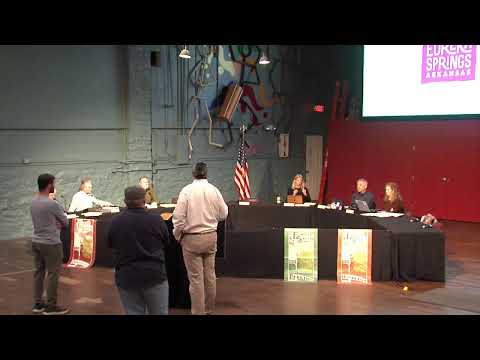
Mayor Pro Tem Steve Holoffield opened a city council workshop on a proposed permanent entertainment district and said he expects the council to ask the mayor’s office and the city attorney to draft an ordinance outlining boundaries and operating rules.
The discussion focused on trade-offs between a single, fixed downtown district and retaining the ability for temporary districts for special events. Council member Terry urged establishing one permanent downtown boundary so the council would not repeatedly review temporary requests. Another council member noted the city previously considered similar measures: speakers summarized that a 2019 change in Arkansas law allowed entertainment districts, a trial run in Eureka Springs was canceled during COVID and two 2020 ballot measures narrowly split voters on the issue.
Why it matters: proponents said a permanent district would support tourism and make the city more competitive with nearby communities by allowing visitors to carry drinks legally across participating businesses; opponents and cautious council members stressed resident concerns, pedestrian safety at state-highway crossings and the need for clear rules and periodic review.
Public-safety, crosswalks and enforcement: Public-safety staff said the department does not expect immediate, permanent staffing increases simply because of a permanent district. "Short answer is yes. We'll still have coverage," a public-safety official, Billy Floyd, told the council when asked whether routine emergency response would be affected.
Officials and council members raised safety questions about any district that would cross Highway 23 (Main Street). A state-highway representative, Simon, warned that sidewalks cannot be placed on state highway property and said that crossing heavy vehicle traffic and private parking lots complicates mitigation; several speakers said this made Option Two (a smaller downtown footprint) preferable.
Administration, wristbands and logistics: Council members and business leaders debated who should administer wristbands, cups and authorization files. The meeting repeatedly referenced a QR-code wristband solution proposed by the presenter, Colin, and several speakers suggested the Chamber of Commerce or CAPC could perform administrative functions. CAPC indicated support: Mike, speaking for CAPC, said the organization would be willing to help, and Devin — who said he had run the plan past his board — said, "Absolutely" when asked whether the chamber would participate.
Producers and long-time organizers said operational details matter. Event producer Jack Moyer and Damon Hanky (who said he served on an earlier mayor’s task force) described prior logistics with wristbands and cups and urged clear authorization procedures for printing wristbands so unauthorized vendors could not replicate them. Hanky said prior efforts showed the central change would be how ABC (alcohol beverage control) law treats open containers inside the district and that temporary permits would still be required for time or space outside the permanent district's parameters.
Drink-size and ordinance-detail disagreement: Council members exchanged differing figures when discussing allowed container size. Several numbers were mentioned during the workshop — 17 ounces, 24 ounces and 16 ounces — and participants did not reach consensus at the meeting; the current ordinance reference was discussed without a single clarified figure in the workshop record.
Next steps: Colin suggested making a motion to draft an ordinance for council review. Council members asked staff and stakeholders to continue refining boundary maps and ordinance details, and they discussed holding additional workshops and a public hearing once a draft is ready. No formal vote was taken at the workshop; the council paused for a five-minute break before the regular meeting.
Clarifying notes: the transcript repeatedly refers to "CAPC" and other local organizations; the transcript did not provide a full, spelled-out name for CAPC, so the article uses the acronym as spoken in the workshop record.
The council did not adopt any ordinance at the workshop; council members signaled they will pursue a draft ordinance and further public review before a vote.