Get Full Government Meeting Transcripts, Videos, & Alerts Forever!
Get email alerts on the Data Center Zoning topic
No spam. Unsubscribe anytime.
Holyoke City Council bans new commercial data centers; carves out existing computing center up to 12 MW
Summary
After hours of public comment warning of water, air and health risks, the Holyoke City Council passed a zoning ordinance prohibiting new commercial AI/data centers citywide while explicitly allowing the existing Green High Performance Computing Center to continue operations up to 12 megawatts.
The Holyoke City Council voted on June 16 to amend the zoning code to ban new commercial data centers across the city while adding a specific carve-out that allows the city’s existing Green High Performance Computing Center to operate up to 12 megawatts.
The vote followed more than three hours of public comment and a lengthy council debate on energy demand, water use and potential environmental justice impacts. Council President Tessa Murphy Rambblei opened the meeting and called dozens of residents to the microphone, many of whom urged a ban or at least a moratorium so the city could study potential harms.
Why it mattered: Residents and local scientists told the council that a proposed 20-megawatt facility could meaningfully increase Holyoke’s peak electrical demand and that backup diesel generators and emissions from cooling systems could worsen air quality in already overburdened neighborhoods. Speakers also raised PFAS (referred to in testimony as “PAS”) risks from certain closed-loop cooling chemicals and noted potential capital costs to treat contaminated water if regulations tighten.
The debate on the council floor centered on two options that had been considered in ordinance committee: (1) adopting a permanent ban on new commercial data centers citywide, or (2) imposing a temporary moratorium while a study committee examined impacts and recommended regulations. Committee members described procedural constraints that prevented reopening the public hearing and explained language changes intended to protect an existing, long-standing computing center the city considers a partner.
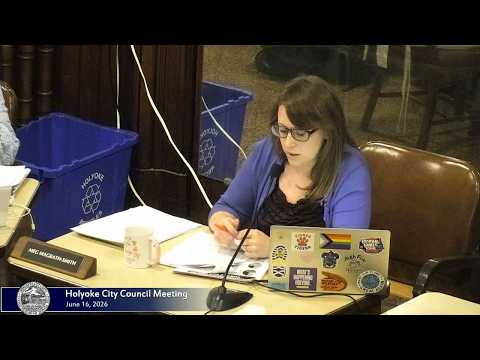
Councilor McGrath Smith moved an amendment to the legal text that explicitly preserved operations at the Green High Performance Computing Center up to 12 megawatts; councilors then approved the amended zoning change. The ordinance passed after roll-call voting. The clerk recorded the final roll call for the ordinance (names as read at the meeting): Toheimer (Yes), Bacon (No), Anderson Burgos (Yes), Divine (Yes), Grainy (No), McGrath Smith (Yes), Mason (Yes), Murphy (No), Hanic (Yes), Purscel (Yes), Israel Rivera (Yes), Jenny Rivera (Yes), Sullivan (No). The measure carried with nine yes votes.
What supporters said: Dozens of residents testified that Holyoke is an environmental-justice community and urged the council to preserve local health and water quality. ‘‘Stop polluting our air, our water. Stop killing our children,’’ said Dr. Gloria Cavayto, a public commenter who asked the council to put residents ahead of outside investment. Environmental scientist Remy Burnham told the council that federal PFAS rules are tightening and that treatment costs could reach ‘‘$500,000 to $10 million’’ per municipality for new treatment capacity.
What opponents said: Some councilors and speakers urged a cautious, regulatory approach rather than an outright ban, warning that a broad definition could unintentionally include research facilities, hospitals or existing data uses. Councilor Bacon and others requested clearer legal language and more publicly available technical analysis, including monitoring data from the existing computing center and more detailed plans for proposed projects.
Next steps and implementation: Council referred the proposed study/ad hoc committee order (item 58) to the ordinance committee for follow-up so the city can study electrical demand, water consumption, environmental impacts, tax revenue implications and best practices. The ordinance’s carve-out language for the existing computing center was included in the final adopted text; the city solicitor and planning staff will publish the formal ordinance text and clarify implementation procedures.
The vote does not affect lawful, ongoing operations at facilities that are currently approved and operating as of the ordinance’s effective date; city staff said permits and grandfathering provisions were considered in the drafting. Council President Murphy Rambblei closed the item and the meeting resumed other business later in the evening.
Community response and next procedural step: Residents who urged the ban said they will continue to press councilors for enforcement language and representation of frontline neighborhoods on the ad hoc study committee. The ordinance now becomes a part of the city code; the ordinance text and implementation schedule will be posted following codification.