Get Full Government Meeting Transcripts, Videos, & Alerts Forever!
Get email alerts on the Screwworm Outbreak topic
No spam. Unsubscribe anytime.
San Angelo declares local disaster after New World screwworm case; officials urge reporting and outline inspection rules
Summary
City and county officials declared a local disaster after a confirmed New World screwworm case, urged ranchers and pet owners to report suspected infections, set up a hotline and website, described a 12-mile infested-zone inspection requirement for livestock movement, and warned of possible economic impact for sheep and goat markets.
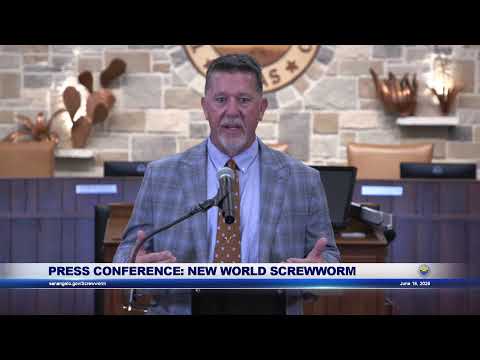
SAN ANGELO, Texas — City and county leaders declared a local disaster after confirmation of a New World screwworm case and urged livestock owners and pet owners to report suspected infections so inspectors and resources can respond.
The mayor opened the press conference by saying San Angelo will "avoid a knee-jerk reaction" and announced the local disaster declaration signed with emergency management coordinator Jose Rivera to enable state and federal assistance. "We signed a local disaster Friday evening ... and what that does is open up some opportunities for us to get federal and state funding and things that help us in assistance through here in the city of San Angelo," the mayor said.
Jose Rivera, the city and county emergency management coordinator, said officials were notified of a possible case between Grape Creek and Carlsbad on Friday morning and had the case confirmed by Friday evening. Rivera said the declaration is a formal step to make sure "our locals are receiving the state and federal resources they need to combat the situation." He announced a public information hub at sanangelo.gov/screwworm and an inspection hotline at 737-292-9983.
Jake Thorne, a small-ruminant extension specialist with Texas A&M AgriLife Extension, described the screwworm as a fly larva that feeds on living tissue and urged animal owners to be informed but not panic. "New World Screwworm ... is certainly something that we all need to take very serious," Thorne said, adding that AgriLife has prepared an online resource hub and a free, roughly four-hour inspector training course to certify people who may assist with livestock movement under Texas Animal Health Commission rules.
Officials and experts stressed that livestock moved out of designated "infested zones" must be inspected by certified inspectors. Rivera said the Texas Animal Health Commission and USDA have established infested zones as roughly a 12-mile radius around confirmed cases and that inspections are required, free of charge, for animals leaving those zones. "In order to move livestock out of that infested zone, they are going to need to be inspected ... by Texas Animal Health Commission inspectors," he said.
On specific animal rules, officials said there are currently no statewide movement regulations for dogs but that owners should consult their veterinarians for protective steps. Horses leaving an infested zone are subject to inspection. Officials added that animals merely passing through an infested zone without stopping generally do not face additional requirements but recommended stopping and checking in at perimeter checkpoints.
Producers raised concerns about interstate market access, particularly for sheep and goats. Charlie Christensen, representing Producers Livestock Auction, said the market is "the largest sheep and goat auction in the United States" and estimated about 350,000 sheep and goats sold at Producers last year, with 70–90% of weekly sales moving out of state. Christensen urged federal and state partners to coordinate with other states to facilitate interstate movement and warned of a measurable economic impact if restrictions persist.
Officials also discussed mitigation measures already under way: state and federal partners have been releasing sterile male flies in reported infested zones and deploying fly traps. Christensen said trap results have shown not one wild screwworm fly caught to date in these traps; the only screwworms recovered were sterile flies released by response teams and marked to allow identification.
On treatment and food-safety concerns, producers and officials cautioned against blindly administering systemic drugs to animals headed to slaughter. The group said medications such as Dectomax and ivermectin can have withdrawal periods; speakers cited typical withdrawal periods of roughly 30–35 days for certain products and warned that improperly timed treatments can lead to carcass rejection at slaughterhouses. Officials directed producers to the Texas Animal Health Commission for specific treatment and movement rules.
Rivera reiterated that the disaster declaration does not guarantee financial reimbursement to producers but signals a request for help and opens channels for resources, inspections and educational opportunities. He said inspections and on-site trap deployment are not being charged at this time.
Officials urged livestock owners to report suspected cases immediately so inspectors can be dispatched, noting one recent example in Gillespie County where a single affected goat recovered after prompt reporting and treatment. AgriLife and the Texas Animal Health Commission plan ongoing outreach, including an extension program on June 29 at 5:30 p.m. at the fairgrounds; organizers asked attendees to RSVP to the Tom Green County extension office.
The press conference closed with a repeat of the hotline number (737-292-9983) and the website (sanangelo.gov/screwworm), and a final appeal to "stay on top of it" by checking animals daily and reporting suspected infections.
Next steps announced by officials include continued coordination with Texas Animal Health Commission and USDA, daily updates to the city website, deployment of inspectors to reported properties at no charge, and local outreach events to educate producers and veterinarians.