Get Full Government Meeting Transcripts, Videos, & Alerts Forever!
Get email alerts on the Graduation Requirements topic
No spam. Unsubscribe anytime.
Parent appeal of SAT-prep graduation requirement denied by Bristol Warren committee
Summary
The Bristol Warren Regional School Committee voted to deny a parent—s appeal seeking an exemption from the district—s new SAT-prep requirement (policy IKF). The policy requires students below PSAT benchmarks (ELA 430, math 480) to complete SAT-prep or an approved alternative; the committee said the rule supports districtwide proficiency goals.
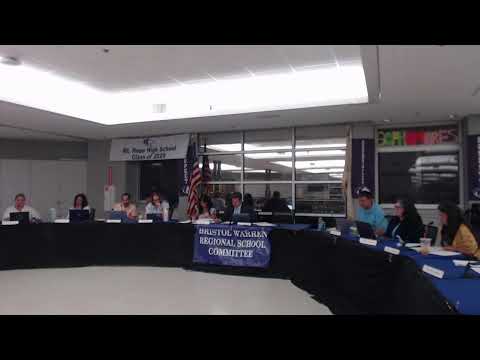
A Bristol Warren Regional School Committee majority on June 15 denied a parental appeal seeking to exempt a Mount Hope High School student from the district—s SAT-prep requirement under policy IKF.
Michaela Fraderelli, who identified herself as the student—s parent, told the committee she was appealing Superintendent Riley—s decision requiring her son to enroll in an SAT-prep course after scoring below the district—s established PSAT benchmarks. Fraderelli argued that standardized tests are a limited snapshot, that her son—s classroom work demonstrates proficiency, and that he intends to pursue a trade rather than a four-year college path. "These assessments primarily evaluate test‑taken performance rather than the full range of skills," she said.
Superintendent Riley explained the district—s policy and the options available to students who fall below the benchmarks. Under the policy adopted in May 2025, students scoring under 430 in PSAT ELA or under 480 in PSAT math are required to complete targeted SAT-prep to address identified gaps. Riley said the district offers several ways to meet the requirement, including a semester SAT-prep course during the school year, an after‑school e-learning option (egeneuity/Khan Academy), summer academy offerings, or an approved private tutor (minimum 18 hours and a certificate of completion). "We offer multiple options if the coursework does not fit a student—s schedule," Riley said, adding that the requirement is part of the district—s strategy to improve proficiency across ELA and math.
Board members questioned whether the state requires SAT-prep classes (Riley said districts do not uniformly require prep courses and that Bristol Warren—s policy "exceeds" typical state practice), whether alternatives are free (district-provided options are free; private tutoring and commercial programs may cost parents), and how many students would be affected. Superintendent Riley said roughly 50 students currently fall below the benchmarks and therefore would be subject to the requirement.
During public and committee discussion members emphasized conflicting priorities: several said standardized test results are an imperfect single measure but nevertheless an important, publicly reported indicator the district must address. Others urged more flexible waiver criteria for students who demonstrate strong classroom performance or established career pathways. Several trustees suggested the policy be revisited by the policy committee later in the year.
On a roll-call vote, the motion to deny the appeal carried: Miss Almeida (yes), Miss Barlo (yes), Mr. Dunovan (no), Miss Richards (yes), Miss Ferrer (no), Mr. Jackson (yes), Miss Piper (yes). One committee member later stated an abstention in discussion; the chair confirmed the motion passed and the student will not receive an exemption from the SAT-prep requirement.
The committee recorded that the appeal was heard in public at the parent—s request. The chair encouraged the parent and superintendent to confer privately after the meeting about available supports and next steps. The committee also encouraged members to consider policy revisions through the policy committee by November if members continue to have concerns about waiver criteria.
Why it matters: the policy affects students who fall below state-aligned PSAT thresholds (district uses the PSAT/SAT as a statewide benchmark for 10th-grade proficiency) and is tied to the district—s strategic plan and accountability reporting. The ruling applies only to the student whose appeal was heard; any broader change to policy IKF would require separate committee action.
Next step: the district will continue to offer the alternative pathways outlined by the superintendent; trustees signaled interest in reviewing the policy later this year.