Get Full Government Meeting Transcripts, Videos, & Alerts Forever!
Get email alerts on the Special Education topic
No spam. Unsubscribe anytime.
Special-education director: 523 students on IEPs, staffing shortages and out-of-district placements strain services
Summary
Jonah Forte, Garfield Heights’ director of special education, told the board the district has 523 students on individualized education programs, 46 students placed out of district across 18 locations, and persistent staffing gaps that drive schedule changes and reliance on contractors.
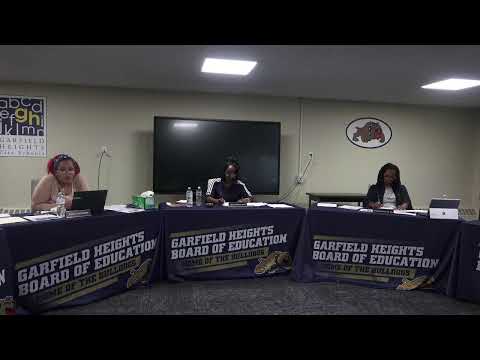
Jonah Forte, the district’s director of special education, told the Garfield Heights City School District Board of Education on June 15 that 523 students were on IEPs this year — a net increase of 12 — and that the district currently has 46 students in out-of-district placements across 18 locations.
Forte said the department oversees IEP and ETR compliance, related services and staffing, and described the district’s least-restrictive-environment continuum from general education inclusion to separate facilities. “It is our obligation and it is the law to have the students in the least restrictive environment,” he said, explaining that an IEP team must determine the appropriate placement.
Why it matters: Forte argued the numbers — and recent expulsions and transfers — have increased pressure on in-district classrooms and driven a need for additional specialized classrooms and staff. He recommended adding a cross-categorical classroom at William Foster and said Pre-K identification rose sharply this year.
Forte detailed building-level counts: William Foster 70 identified (up 23), Pre-K 57 (up 21), Elmwood 44, Maple Leaf 89, Middle School 107, and High School 156 (a decrease of 35). He said out-of-district placements are often driven by behavioral or medical needs and may remain in place through graduation.
On staffing, Forte listed specialist roles and contracted vendors the district uses to fill gaps: school psychologists, speech-language pathologists, occupational and physical therapists, paraprofessionals, BCBAs and registered behavior technicians, and contracted providers including EduHealthcare, Staff Therapy, ProCare, Soliant, PSI and North Coast Therapy. He said the district uses third-party contracts when positions are hard to recruit or require specialized skills.
Board members pressed for operational details. Forte said caseload maximums are 16 for K–8 intervention specialists and 24 for high school. When asked how services are maintained while vacancies exist, he said schedules are adjusted, long-term substitutes are used (who can deliver services but not author IEP documents), and active recruitment continues year-round. “When caseloads get high, the focus becomes can I give the students what they legally need,” he said.
Forte described initiatives intended to improve student outcomes and wellbeing, including trauma-informed supports (a care navigator supported by Cleveland Clinic Foundation partners), an expanded Beyond Words music-therapy program, and an equestrian program at Fieldstone Farm. He also reported improvement in cohort graduation rates for students with disabilities, noting that special-education graduation has risen over recent years and reached about 91.4% for the latest cohort he cited.
Board members asked for and received clarifications on assessment reporting periods, the process for manifestation determination reviews (MBRs), and the frequency of out-of-district visits (weekly to quarterly depending on provider and placement). Forte said staff should notify him when an MBR is pending and that the team has been trained in the process.
What happens next: Forte recommended additional classrooms and ongoing contracting for specialist staffing; the board did not take a formal vote on program changes at the meeting.
Ending: The board moved on to the Education Advancement presentation after a sustained Q&A with Forte about caseloads, contracted services and transitions back from out-of-district placements.