Get Full Government Meeting Transcripts, Videos, & Alerts Forever!
Get email alerts on the Financial Aid topic
No spam. Unsubscribe anytime.
System analysis flags 56,000 undergraduates with 'PELL eligibility unknown'; trustees push FAFSA outreach and consider workforce PELL options
Summary
Analysts told trustees one‑third of undergraduates were categorized as 'PELL eligibility unknown' (about 56,000 students in FY25); trustees directed exploratory follow‑up and discussed Workforce PELL (new federal/state short‑term aid rules) and how the system might qualify employer‑vetted short programs.
Minnesota State analysts reported to trustees that roughly 36% of the system’s undergraduate enrollments are currently classified as “PELL eligibility unknown,” a pool that represented about 56,000 students in FY25. After removing international and non‑degree enrollees, presenters said about 31,263 degree‑seeking undergraduates remain as potentially actionable — students who might be eligible for Pell grants if they complete a FAFSA or if missing data can be resolved.
The finding drew immediate trustee attention. Several trustees asked system leaders to treat the unknown category with urgency — to identify which students could be reached with FAFSA outreach and to return with near‑term plans for the fall enrollment cycle. Dr. Shaw called the finding “an exploratory opportunity” and noted the limits of current reporting: noncredit and some admission statuses are excluded from Pell‑eligibility calculation, and FAFSA completion data are not uniformly available for all students.
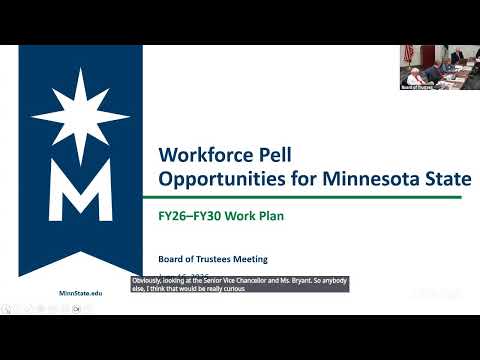
Trustees also discussed Workforce PELL, the federal/state initiative to make short (8–15‑week), employer‑vetted training programs Pell‑eligible. System staff summarized eligibility rules circulating in guidance: eligible short programs must be high‑quality, employer‑informed, have demonstrable completion and placement outcomes (guidance references thresholds such as a 70% completion/placement standard in comments), and in many cases require evidence that the credential stacks into a larger postsecondary pathway. Staff said Phase‑1 (initial approvals) begins July 1, but most campuses will need time to collect required program, outcome and placement data and to confirm alignment and stackability before certificate programs will be recommended for formal state/federal approval.
Trustees and presidents discussed practical barriers: noncredit data and administrative infrastructure are uneven across campuses; some short programs will need curricular or scheduling adjustments to meet narrow federal length windows; and employers must play active roles in curriculum design and placement reporting. Presidents said some low‑hanging programs (for example, well‑established healthcare pipeline certificates) could be early candidates if campuses provide the required outcome data and employer vetting.
System leaders outlined next steps: (1) pursue targeted FAFSA outreach for students in the PELL‑unknown pool; (2) work with campuses to identify pilot Workforce PELL programs that meet state/federal guidance and collect required data; and (3) develop system‑level supports for noncredit data capture, prior‑learning credit mapping and employer partnerships. Trustees asked for an early autumn report on progress and emphasized the need for both urgency (for fall enrollment) and caution (to ensure program quality and transfer/stacking pathways).