Get Full Government Meeting Transcripts, Videos, & Alerts Forever!
Get email alerts on the Eqi User Guide topic
No spam. Unsubscribe anytime.
Caltrans presenters and advisory members press for clearer, more accessible EQI user guide
Summary
Caltrans staff and subcommittee members reviewed a draft Equity Index (EQI) User Guide and recommended clearer onboarding, language access, a 500‑meter buffer and searchable locators for SB 960 screening, improved layer visualization, and an external testing period; the subcommittee adopted April minutes by roll call.
Caltrans staff presented a draft Equity Index (EQI) User Guide to an advisory subcommittee on accessibility, usability and compliance tools, and subcommittee members urged stronger onboarding, language access, and built‑in screening tools.
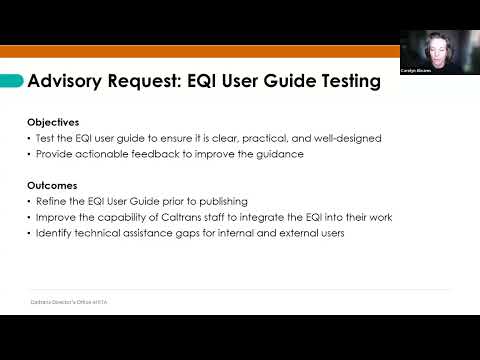
The presentation, led by Macy Nerani, Caltrans’ Equity and Data Policy Advisor, summarized user testing with three participants and four exercises designed to assess map navigation, layer interpretation, proximity analyses and the EQI’s add-on analytical tool. "The EQI user guide is effective for identifying underserved communities and transportation burdens," Nerani said, but she added that "proximity analysis and geospatial measurements required more trial and error."
Committee members focused on three practical shortfalls: accessibility for non‑GIS users, language access, and technical workflow for statutory screenings. Member Martha Armas‑Kelly told the group that the tool and guide must be accessible across languages and abilities, urging a clear translation icon and onboarding that assumes no GIS experience. "If it's not accessible, then we're not really being equitable with the EQI," she said.
Presenters acknowledged those concerns and said the current guide is intended first for internal Caltrans staff, with a separate public‑facing version planned. Carolyn Abrams, senior advisor for transportation equity in Caltrans’ Director’s Office of Equity and Tribal Affairs, said Caltrans will combine internal and external feedback and pursue additional technical changes. "We will be working on a revised version of this user guide for an external audience," Abrams said, and staff in Caltrans’ data and digital services will handle in‑house technical issues.
Members recommended specific product changes to reduce user errors and speed common tasks: an on‑ramp and intersection locator, a pre‑built 500‑meter buffer or an automated SB 960 eligibility screen, an obvious "start here" onboarding flow for lay users, in‑map feedback/reporting buttons, and improved visual patterns for distinguishing multiple overlaid layers. "It would be helpful to start with the big picture roadmap: why is this tool important, who should use it and what it can and cannot do," said another member, urging clear statements of minimum connectivity or browser requirements.
Presenters also described the EQI strengths observed in testing: the underserved communities layer and transportation burden layers were generally clear and immediately understandable to some users. But several participants reported difficulty creating ArcGIS accounts, aligning project corridors precisely, and differentiating the analytic add‑on from the main web map. Macy Nerani summarized common recommendations: "Add a quick start guide or onboarding walkthrough, implement a searchable corridor/intersection locator, introduce a built‑in 500‑meter buffer or automated screening function, and create interactive tutorials."
Caltrans staff said they will pursue a mix of documentation and technical improvements this summer and plan a broader external testing period before releasing a public guide. They also invited the subcommittee and partner organizations to help recruit testers, including smaller jurisdictions and students, to evaluate the external version.
Votes at a glance: the subcommittee adopted the April 16, 2026 meeting minutes by roll call after quorum was reached. Member Martha Armas‑Kelly made the motion and Member Howard Wong seconded; the clerk recorded unanimous affirmative votes.
The subcommittee will reconvene in September to review revised materials and next steps. The presentation materials and contact information for submitting technical issues will be provided by staff for follow‑up.