Get Full Government Meeting Transcripts, Videos, & Alerts Forever!
Get email alerts on the Family Law Child Support topic
No spam. Unsubscribe anytime.
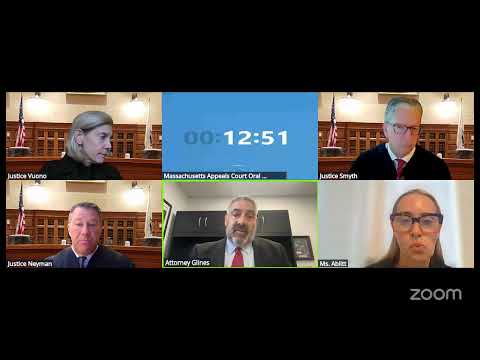
Appeals Court hears argument that trial judge ignored bank records in child-support ruling
Summary
At a virtual Massachusetts Appeals Court hearing, pro se appellant Nicole A. Ablett argued the trial court ignored bank records showing six-figure deposits and relied on lower tax-return figures when calculating income under the Massachusetts child support guidelines. Respondent counsel defended the trial judge's factual inferences; the panel took the case under advisement.
BOSTON — Nicole A. Ablett, appearing pro se, told a three-justice panel of the Massachusetts Appeals Court that the trial court erred by discounting admitted bank records and relying instead on tax returns when calculating her former spouse’s income for child-support purposes.
"The bank records show over $815,000 in receipts, but the court relied on a 145,000 tax return that wasn't supported by any documents," Ablett said during oral argument in case no. 2025-1024. She urged the panel to vacate the trial court’s judgment, saying the record contained undisputed financial records that the trial judge failed to credit.
The appeal centers on whether the trial court correctly attributed income and applied the Massachusetts Child Support Guidelines, which require consideration of "all income from whatever source." Ablett told the panel the judge adopted reported tax figures — $145,000 for 2020 and $445,000 for 2021, she said — while ignoring bank deposits she described as far larger, including $815,000 and $592,000 in deposits reflected in admitted bank statements.
"The guidelines required the court to consider all income from whatever source," Ablett said. "Here the court excluded substantial actual receipts that reflected in the bank records and relied instead on unsupported reported income which resulted in an artificially low income figure."
Justice Ariane Bueno, who presided over the oral argument, repeatedly questioned how the appellate court could overturn a trial judge’s credibility findings. "Our court is bound by credibility determinations," she said, asking Ablett to explain how the panel should approach what appeared to be a credibility-based ruling.
Ablett told the panel the issue was not simply witness credibility but the trial court’s apparent refusal to accept certain documentary evidence and its reliance on findings she described as unsupported by exhibits or witness testimony, such as a $100,000 deposit the trial court attributed to the sale of a former marital home.
Respondent counsel Attorney Glantz defended the trial judge’s rulings, urging deference to the factfinder who observed witnesses and weighed competing evidence. "Voluminous — there were 19 exhibits, tax returns from all the years," Glantz said, arguing the record supported reasonable inferences the trial court drew from the exhibits and testimony.
Glantz also argued that any dispute about accounting or income attribution did not require expert testimony and that the judge’s line of questioning and review of the record supported the result. He referenced record evidence and prior proceedings in which an attorney, identified in argument as Christopher Carboni, was discussed in connection with earlier litigation.
The panel said the briefs and oral arguments "fully explained" the issues and announced it would take the case under advisement and issue a decision as soon as possible. No additional filings or dates were announced during the hearing.
The Massachusetts Child Support Guidelines were cited at argument as the controlling standard for income attribution; the panel did not rule from the bench at the conclusion of oral argument.