Get Full Government Meeting Transcripts, Videos, & Alerts Forever!
Get email alerts on the Legacy Standards topic
No spam. Unsubscribe anytime.
Battleground Council reopens conversation on 1999 ‘legacy standards’ amid calls to update setbacks and parking
Summary
City staff summarized the origin and goals of Battleground’s 1999 legacy development standards and Council signaled interest in targeted updates — particularly around on‑street parking, setbacks, and emergency access — directing staff to draft zoning‑sensitive changes for future hearings.
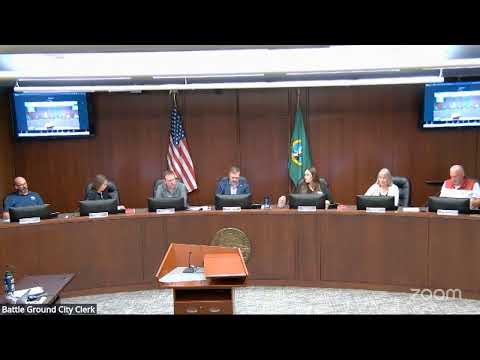
City staff on Monday walked the Battleground City Council through the history and intent of the city’s legacy development standards adopted in 1999 and recommended a staged, code‑aware approach to any changes.
Kristen, the city presenter, reminded the council that the concept began after a 1998 retreat and resulted in Ordinance 99‑04, which introduced standards intended to promote walkability, mixed uses and design consistency. “The goal of establishing these legacy standards was to find that balance and help create a livable, walkable, sustainable community,” she said during the study session.
Council members pressed staff on how much of the 1999 framework remains and whether it still suits Battleground’s current growth patterns and lot sizes. “A lot of the framework that was adopted in 1999 still exists today in our development code,” Kristen said, noting the code is updated annually to comply with the Washington Growth Management Act and other state rules.
Several councilors urged changes in specific areas. Council Member Bowman and others pointed to neighborhood examples where planter strips, narrower lots and the encouragement of on‑street parking have reduced driveway capacity and, they argued, complicated emergency access. One councilor cited the Park View Trails area as an example of stub streets that were later isolated by wetlands protections and not connected to adjacent development.
Mark, a public works/engineering speaker, told the council that wetlands and state and federal wetland protections have sometimes blocked connections the code originally intended, but that existing municipal procedures — including road vacations and easements — can address unused street segments when appropriate.
On procedures, the council directed staff to prepare a draft ordinance that would treat trailer and RV storage and similar code edits in a zoning‑sensitive way, taking into account lot size, setbacks and minimum clearances for emergency access. The motion directs staff to return a draft for review in biweekly meetings before any public hearing is scheduled. Council members emphasized keeping any rewrite simple and tied to existing zoning distinctions so R‑1 or larger lots would not be unduly constrained while denser zones would have stricter limits.
Next steps: staff will produce a draft ordinance that includes zoning‑based allowances, setback and clearance options and clear language for driveways and pads. The council asked for the draft to come back for internal review before a public hearing date is set.