Get Full Government Meeting Transcripts, Videos, & Alerts Forever!
Get email alerts on the Solar Energy topic
No spam. Unsubscribe anytime.
Calcasieu Planning board approves roughly 1,100‑acre Southern Prairie solar facility after mixed public comment
Summary
The Calcasieu Parish Planning & Zoning Board approved a zoning exception for the Southern Prairie Solar and energy storage project—about 1,100 acres—after proponents cited resilience and local co‑op support and a nearby resident warned of flooding, wildlife loss and storm hazards; construction is tentatively planned for 2027 and permitting remains required.
The Calcasieu Parish Planning & Zoning Board on June 16 approved a zoning exception allowing the Southern Prairie Solar and energy storage project to proceed on roughly 1,100 acres in South Homewood.
The decision followed a staff recommendation to grant the exception with conditions, several minutes of pro‑project testimony from local groups and energy advocates, a detailed technical response from the project's engineers, and a single, extended public comment in opposition. Board member Julia Dickerson made the motion to approve; Ms. Dickerson was seconded by Letricia Cobb. A roll‑call vote was read aloud and the chair announced the motion passed.
The project developer and supporters said the facility would diversify energy sources, strengthen local grid reliability and deliver tax and employment benefits. Margaret McKenna, representing Southern Prairie Solar LLC, introduced the application and reserved time to respond to public comments. Proponents included Cynthia Robertson, founder of Micah 6:8 Mission, who said her organization uses community solar to support disaster preparedness and service delivery, and Sipho Mongoeisium Gosi Monte of Vessel Project of Louisiana, who framed the project as part of regional clean‑energy priorities and cited high local pollution burdens.
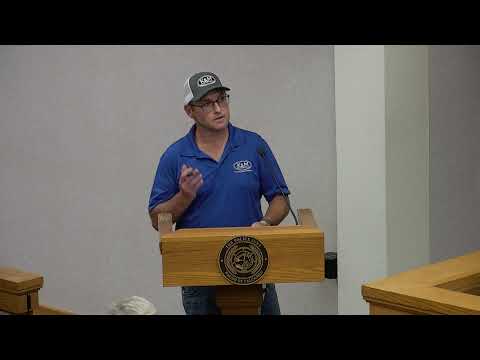
Opposition centered on local drainage, storm safety and land‑use impacts. Nearby resident Steve Vance said the 1,100‑acre footprint would ‘‘threaten our safety, our way of life, and the land we call home,’’ warning that scraping the soil and installing large arrays would increase runoff, overload neighborhood ditches and create hazardous debris in hurricanes. He urged the board to deny the zoning change to protect homes, farms and wildlife.
Project engineers and the applicant responded to those concerns with technical and operational reassurances. Chris Guidry of Fenstermaker & Associates told the board the developer plans a stormwater pollution‑prevention plan, best‑management practices during construction, landscape buffers and limited internal roadways; he said most of the site would be planted with vegetation rather than subject to full site grading. The applicant said the fixed‑tilt racking system planned for the site is certified to meet high wind standards (the team cited 150 mph design certification and ASCE standards) and that panels require special recycling at end of life rather than ordinary landfill disposal.
The board asked about timing, traffic and who would receive electricity. The developer said construction is tentatively scheduled to begin in the third quarter of 2027, with a 12–18 month construction window (longer in wet conditions), and that the project anticipates about five to seven permanent operations employees plus two to four workers for battery operations. The applicant clarified that electricity generated would flow into the transmission system owned by Jeff Davis Electric Co‑op and be distributed through that network, not diverted directly to individual homes.
Planning staff noted conditions including adherence to the site plan on file with the Division of Planning and Development, allowing the director or designee to authorize technical adjustments, and required permitting from Consolidated Gravity Drainage District No. 2 East and compliance with Section 26‑99 of the Calcasieu Parish Code of Ordinances governing solar facilities.
At the vote, board members verbally recorded their positions on the record; one board member recorded a ‘‘No’’ vote during roll call while the chair announced the motion passed. Because the Southern Prairie Solar application was processed as a zoning exception, staff had noted exceptions are final actions of the board for tonight's meeting; the project will proceed to required permitting and any agency approvals described in the staff conditions.
Next procedural steps described in the meeting record were permitting and site engineering required before construction. The board also approved other, unrelated zoning and rezoning items during the same meeting and adjourned with the next meeting scheduled for July 21, 2026.