Get Full Government Meeting Transcripts, Videos, & Alerts Forever!
Get email alerts on the Professional Teaching Standards topic
No spam. Unsubscribe anytime.
State board opens professional teaching standards for revision to align with federal Executive Order 14151
Summary
The Arizona State Board of Education voted to open the Arizona Professional Teaching Standards for revision so an expert working group can identify language to align the standards with Executive Order 14151; board and department leaders said compliance is needed to avoid risking more than $860 million in federal funds.
The State Board of Education voted to open the Arizona Professional Teaching Standards for revision to identify wording that must be changed to comply with federal Executive Order 14151.
Sid Bailey, speaking for the department, told the board the order “gives us direction to eliminate all DEI language and the type from all of our work,” and said the state faces a risk to federal education funding if the standards are not updated. Bailey said that risk for Arizona exceeds $860 million.
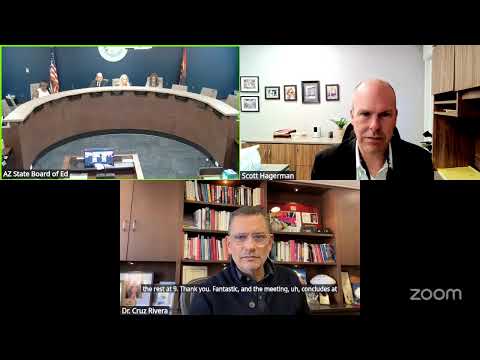
Board member Dr. Cruz Rivera moved that the board open the standards for revision “to identify and recommend possible changes needed to align with federal Executive Order 14151,” with the condition that an expert working group establish specific definitions and limit recommendations to technical alignment while preserving necessary pedagogical language. Superintendent Horn seconded the motion and the board approved it.
Under the department's plan, the working group would include elementary, middle and high school teachers, school administrators, representatives from education preparation programs, parents and county and LEA superintendents; staff said they will attempt to include representation from all 15 counties. The department proposed beginning outreach in January, convening the group in February, updating the board every other month and aiming for a draft to return to the board by September.
Board members asked about nomination and participation processes. Dr. Clay asked whether individuals could self-nominate; Bailey said the department plans to solicit recommendations and might accept self-nominations depending on response levels. Board members also asked whether they could observe working-group meetings via Zoom; department staff said that could be permitted so long as board members do not interfere with the committee's work.
The board's action opens a rule-revision process and charges the department to assemble the stakeholder group and return with definitional work and technical alignment recommendations for the standards.