Get Full Government Meeting Transcripts, Videos, & Alerts Forever!
Get email alerts on the Teaching Standards topic
No spam. Unsubscribe anytime.
Board tables proposal to revise teaching standards after heated debate over federal directive
Summary
Board members debated opening a review of the Arizona professional teaching standards and an SEI endorsement framework in response to federal executive order 14151; after extensive Q&A about federal funding risk and committee scope, the board voted to table both items until Dec. 8 to allow staff to provide more information.
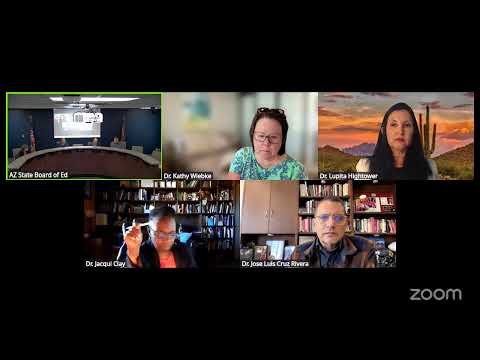
The Arizona State Board of Education on Oct. 13 debated whether to open a process to revise the state's professional teaching standards and the Structured English Immersion (SEI) endorsement course framework, then voted to delay a final decision until its Dec. 8 meeting.
Why it matters: Department staff said federal communications tied to Executive Order 14151 have asked states and institutions to end certain programs or verbiage described as diversity/equity/inclusion (DEI/DEIA) and warned that federal financial assistance could be at risk if compliance was not certified. Staff said federal funds to Arizona exceed roughly $860 million, prompting requests to review rule language and course frameworks for potential conflict with federal directives.
Associate Superintendent Sid Bailey asked the board to open rule R‑7‑2‑602 to revise Arizona's professional teaching standards, citing federal concern about certain terms and noting that university educator-preparation programs had reported federal review. "In January of this year, we received an executive order 14151 from the US Department of Education ... directing us to end all discriminatory programs including DEI," Bailey said.
Deputy Associate Superintendent Adella Santa Cruz asked the board to open a separate process to revise the SEI endorsement course framework (approved in 2020) and showed sample redline edits staff said were intended to align the course language with the executive order.
Board members raised procedural and substantive concerns: several asked for a clearly defined charge for any working group, broad and transparent stakeholder representation (including counties, universities, community colleges, teachers and parents), and clarity on whether national INTAS (InTASC) standards are being revised. Dr. Webbkkey and others urged staff to confirm whether national standards are being updated before convening a state working group; Dr. Clay and others asked for national experts and public transparency in member selection.
Superintendent Tom Horn framed the immediate risk in budgetary terms: "The charge would be we need you to help us be sure that we don't lose $800 million," he said, urging the board to avoid a funding cutoff. Staff emphasized that opening the review is the first step and that any rule changes would come back to the board for approval after public review.
The board voted to table both the request to open the professional teaching standards for revision and the request to open the SEI endorsement framework revision until the board's December meeting to allow staff time to answer outstanding questions and present recommended committee composition and a defined charge.
Next steps: Staff will return in December with additional information about the national standards timeline, proposed charge and stakeholder-selection process; no rule changes will occur until the board votes to open formal rulemaking.