Get Full Government Meeting Transcripts, Videos, & Alerts Forever!
Get email alerts on the City Budget topic
No spam. Unsubscribe anytime.
Panama City staff present $2.5M shortfall as worst‑case $4.5M cuts would hit police, fire and public works
Summary
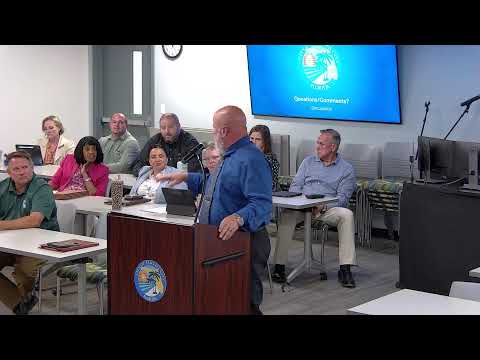
At a June 11 pre‑budget workshop, Panama City staff showed scenarios for a $4.5 million general‑fund cut and a revised $2.5 million shortfall. Department leaders warned that cuts could eliminate police shifts, close a fire station and defer maintenance; commissioners asked for more data and scheduled follow‑up workshops.
City officials on June 11 reviewed staff modeling that shows the City of Panama City may face a general‑fund shortfall of roughly $2.5 million for FY27, while also receiving an exercise scenario showing how a larger $4.5 million reduction would affect city services.
City Manager Jonathan opened the pre‑budget workshop by telling commissioners the presentation focused on the general fund and that enterprise funds and rate‑driven services would be addressed separately. He said staff had previously used a March projection of a $4.5 million gap and were asked to show departmental plans for that scenario; updated ad valorem figures and insurance‑premium reallocations have substantially narrowed the gap to an estimated $2.5 million.
The presentation outlined two paths: a smaller, updated $2.5 million gap that staff said could be addressed largely by freezing vacancies and other targeted savings, and a contingency $4.5 million option that would require deeper program and personnel reductions. Jonathan told the commission there are currently 23 vacant general‑fund positions representing about $1.3 million in salary and benefits.
Staff walked commissioners through high‑level department impacts if the $4.5 million option were implemented. For the police department, staff‑provided scenarios showed losing 16 positions would effectively eliminate an entire shift, return staffing to levels seen in 2006 and raise response times, overtime and equipment‑maintenance costs. Chief Mark Smith, of the Panama City Police Department, told the commission those cuts "will set us back 30 years," saying the department already operates at pay scales below most neighboring agencies and that reductions would worsen officer safety and morale.
The fire department scenario presented by staff projected approximately seven position reductions and the possible closure of one station, which staff and Chief David Collier said could significantly increase response times and risk the city’s ISO rating.
Public Works Director Clint Murphy warned the commission that the presented shortfall was benchmarked to FY26 and did not fully capture recent inflation for fuel, asphalt and concrete, meaning actual operating pressure could be larger. Staff said the public‑works reductions shown for the general fund would eliminate several maintenance positions and reduce the city’s ability to respond to potholes, drainage and sidewalk repairs—raising the risk of property damage claims.
Staff also listed administrative and program reductions that would help close gaps: pausing the state lobbying contract (~$90,000), removing the Destination Panama City contract (~$100,000), pausing budget‑software spending (~$100,000), suspending two hired contractors (~$36,000), and potential early payoff of a $150 million short‑term loan with an estimated minimum interest savings of $500,000. The presentation noted other revenue and cost adjustments that collectively reduced the earlier $4.5 million projection to about $2.5 million.
Commissioners pressed staff for more granular information and questioned whether the commission should treat the $4.5 million scenario as the working target now that staff estimates had improved. Several commissioners said they preferred to let departments present what they would like restored when updated revenues are available rather than immediately budgeting newfound revenue. They asked for department‑level budgets, staffing breakdowns by salary band, and service‑level metrics (for example, how quickly a sidewalk repair would be resolved) before making final trade‑off decisions.
The commission and staff discussed alternatives and next steps. Commissioners and directors suggested exploring shared purchasing or other intermunicipal collaborations, early debt termination or property sales to bolster reserves, and a deeper look at duplicative services (including a conversation about dispatch and mutual/automatic aid). Logistics Director Sean Self described existing cost controls (phone audits, energy‑bill reviews) and noted his department had already reduced its budget in response to the exercise.
No motions or votes were taken at the workshop. Commissioners agreed to additional, more focused workshops so department directors can present detailed budgets and service priorities: staff proposed dates including a June 29 session and in‑person workshops on July 6 and July 16, ahead of a proposed millage setting on July 28 and tentative and final budget hearings in September.
Public commenter Patty Sunday Fairland urged that staff include measurable service metrics in future presentations (for example, days to fix a sidewalk) to give commissioners concrete data for prioritization.
Next procedural steps for the commission are clearer departmental presentations at the scheduled workshops and receipt of the updated revenue projections ahead of any millage discussion. The commission made no formal decisions at the June 11 workshop.