Get Full Government Meeting Transcripts, Videos, & Alerts Forever!
Get email alerts on the Charter School topic
No spam. Unsubscribe anytime.
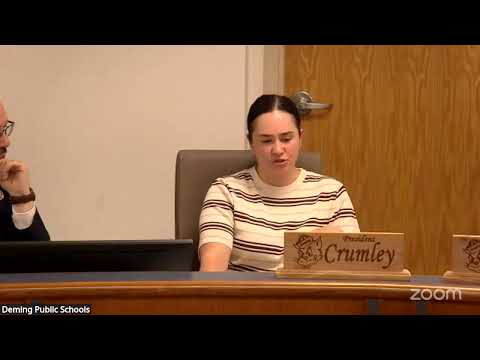
Board weighs response to proposed state‑authorized K–8 charter; staff to draft resolution
Summary
Board members discussed a notice of intent for a state-authorized K–8 charter in Deming, raised concerns about transportation, special-education capacity and whether the application demonstrates uniqueness, and heard staff estimates that up to 400 students could shift roughly $5.8–$6 million in state funding away from the district; staff will draft a resolution for the board to consider next week.
Board members discussed a notice of intent to establish a state‑authorized K–8 charter school in Deming and asked staff to draft objective communications and a possible resolution for the Public Education Commission (PEC).
Staff explained the proposed school would be state‑authorized (not district‑authorized) and could enroll up to about 400 students over five years. The presentation included rough funding estimates: a base unit value discussed at about $7,700 and an average per‑student funding figure of roughly $14,000–$15,000 when additional factors are included; staff estimated a five‑year revenue shift in the range of $5.8 million to $6 million if enrollment reached 400 students. Those figures were presented as staff calculations and as numbers shown in the charter application materials.
Board members raised multiple concerns: whether the charter application demonstrated a material uniqueness compared with current district programs; whether the proposal’s lack of transportation would filter out students who need services; special‑education capacity and readiness of facilities; and the accuracy and sufficiency of financial projections. One board member said the application “seemed AI generated” and lacked substantive differentiators, while others urged the board to communicate objectively to PEC about community impacts.
Several members emphasized that the PEC is a statewide body and that local elected representatives have a duty to explain local context to the state reviewers. Staff said they would draft a resolution for board consideration next week that could articulate the board’s concerns about financial stability, special‑education capacity, facility readiness and transportation, and authorize leadership to follow up with PEC and community stakeholders.
Next steps: staff will prepare a draft resolution and related communications for the board’s next meeting; the board may vote on a formal position before PEC takes formal action and holds public input in Deming.