Get Full Government Meeting Transcripts, Videos, & Alerts Forever!
Get email alerts on the Education Budget topic
No spam. Unsubscribe anytime.
Southington board rejects $310,000 emergency appropriation for schools, seeks more detail
Summary
The Board of Finance voted 0–5 to deny a $310,000 appropriation requested by the Board of Education to cover a 2024–25 operating shortfall, while agreeing to continue work in July on options including the BOE's non‑lapsing reserve and procedural fixes for state education funds.
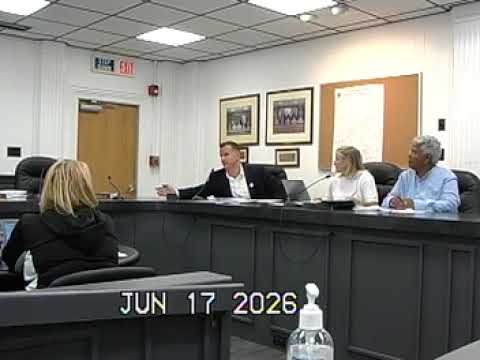
The Southington Board of Finance voted unanimously to deny a $310,000 appropriation requested by the Board of Education to close an operating shortfall, leaving school leaders to pursue other options and more detailed follow‑up later this summer.
The Board of Education representative told finance members the district faces a roughly $300,000 shortfall for the 2025–26 year, driven by mandatory costs including contracted purchase services to backfill specialized staff on extended family or medical leave and higher out‑of‑district special‑education tuition. “This appropriation is necessary to close the gap created by unavoidable costs and continue providing appropriate services to Southernington students,” the representative said.
Board members pressed for clarity about two related issues: a timing anomaly tied to educational cost‑sharing (ECS) revenue from the state and whether the BOE should use non‑lapsing reserve balances to close the current shortfall. Finance staff and BOE officials explained that roughly $833,900 in ECS funds arrived after the town’s budget adoption and currently appears in the town’s general fund; the town intends to appropriate that revenue back to the BOE in the new fiscal year, which creates a temporary appearance of a larger cut in the BOE starting budget.
School officials also itemized the drivers of the current shortfall: roughly $525,000 in contracted services to replace specialized staff (psychologists, speech‑language pathologists and social workers), approximately $296,000 in outplaced special‑education tuition, and higher substitute and non‑certified support costs. The BOE representative said these expenses are largely non‑discretionary and tied to legal and educational obligations.
Officials discussed using the BOE’s non‑lapsing fund to close the gap and then asking for separate appropriations for capital projects that would be delayed; several finance members signaled support in principle for that approach but raised procedural concerns about how to add such items to the agenda. “One of the problems is because at one point … the mill rate was set and we can’t reset it,” a board member said, urging a fuller review in July when all relevant officials are present.
When the appropriation motion came to a roll‑call vote, the board recorded five ‘no’ votes: Mr. Levenick, Mr. Bodoyne, Mr. Serno, Mrs. Wade and Chair Larry. The motion failed 0–5.
What’s next: board members asked the BOE and finance staff to prepare more detailed documentation — trends in family‑leave usage, special‑education drivers, and non‑lapsing account balances — and to address the procedural steps required to appropriate post‑budget revenue or to deploy reserves. The board and the BOE expect to revisit these items at a July workshop or the July meeting.