Get Full Government Meeting Transcripts, Videos, & Alerts Forever!
Get email alerts on the General Plan Update topic
No spam. Unsubscribe anytime.
Safford approves draft 2026 general plan for agency review after wide discussion on housing, water and fees
Summary
The Safford mayor and council, joined by the Planning & Zoning Commission, approved the updated 2026 draft general plan to go to agency review, after presentations from the Planning Center, public comment and debate on housing tools, water capacity and development fees.
Safford’s mayor and council on Feb. 23 approved the updated 2026 draft general plan to send out for agency review and to be considered at public hearings this spring, setting the stage for voter ratification in November.
Planning consultant Garrett Alre of the Planning Center opened the work session with an overview of the draft, describing it as a consolidated, more user‑friendly document that combines the 2016 background and the policy volumes into one 135‑page plan. He told the joint meeting of council and the Planning & Zoning Commission that the draft moves implementation details—lead departments, expected timelines and progress reporting—into chapter summaries to make follow‑up more actionable for staff.
The presentation summarized the city’s public outreach effort: 380 survey responses showed residents value Safford’s ‘‘small‑town atmosphere’’ and prioritized additional restaurants/retail (126 votes), high‑quality public services (124 votes) and a variety of safe, affordable housing (124 votes). The draft revises the vision statement to emphasize a balance of small‑town character with broader economic opportunity and ‘‘attainable housing that guide[s] responsible growth,’’ language the presenter said is meant to be concise and usable by staff and developers.
Alre walked the group through how the plan would support housing near existing infrastructure and described specific policy and action‑item tools to make projects feasible, including government property lease excise tax programs (GPLET), low‑income housing tax credits (LIHTC) and community land trusts. Using a hypothetical proposal by Mount Graham Regional Medical Center for 45 workforce housing units on a three‑acre infill site, he illustrated how the plan’s goals (including Goal 6.1 on housing diversity and Goal 1.1 on strategic growth) would support such a request while flagging potential constraints from existing R2 zoning standards (50% lot coverage, parking and height limits).
The presentation recommended options to reconcile plan aims with code limits: use of planned unit developments (PUD) or planned area development (PAD) districts to set project‑specific standards, or targeted amendments to the zoning code so the code better enables the housing types the plan encourages.
Water capacity was a recurring concern. A Planning & Zoning member noted drought and asked how the city would ensure sufficient water for growth. Staff pointed to a recent community water system plan prepared by Westland Engineering (October 2025) and explained that reclaimed‑water output is currently below potential; increasing output depends on securing additional sewer connections and customers for reclaimed water. Utility Director Jeff Low said capacity fees have been reduced in recent years (from roughly $4,000–$5,000 down to about $500 for a residential home connection), a change council members raised during discussion about cost burdens for small businesses.
Council members also flagged factual edits for the draft—removing an incorrect sentence that said the city provides recycling—and asked staff to change wording from ‘‘impact fees’’ to the city’s practice of charging ‘‘capacity fees’’ where appropriate. Staff said those technical edits would be made before the next distribution to agencies.
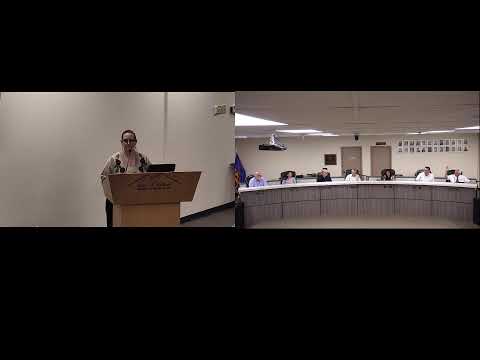
Public comment included a statement from Kim Martin, a local educator, who said one teacher position had been cut at her school because of low enrollment and urged council to consider such trends when planning to attract new businesses and growth.
After questions and edits were noted, a council member moved to approve the adoption of the updated 2026 draft general plan as a draft for agency review and further public process; another council member seconded the motion. The council called the question and approved the motion. Staff said the Planning & Zoning public hearing will be Monday, May 18 at 6 p.m., followed by a mayor‑and‑council hearing in June (either June 8 or June 22), with the measure slated for the Nov. 3 ballot for final ratification.
The work session closed with staff committing to incorporate edits, further outreach results and agency comments into the draft before the scheduled public hearings.