Get Full Government Meeting Transcripts, Videos, & Alerts Forever!
Get email alerts on the Land Use Data Centers topic
No spam. Unsubscribe anytime.
Planning commission tables data-center zoning text, asks staff for environmental expertise
Summary
After a 90-minute presentation on data centers from consultant Chris Lloyd, the Dickinson County Planning Commission voted to table TXT-2602 and directed staff to gather more information — including an industrial hygienist — on water use, noise and wastewater before drafting any zoning changes for data centers.
The Dickinson County Planning Commission on a voice vote tabled consideration of TXT-2602, a proposed amendment to Article 21 of the county zoning regulations that would add provisions for data centers, and directed staff to gather additional environmental expertise.
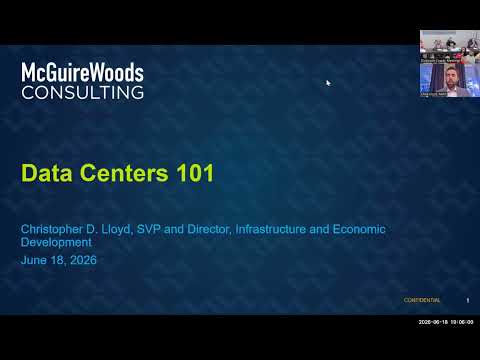
Consultant Chris Lloyd of McGuireWoods Consulting told commissioners he intended to give a neutral "data-center 101" presentation to explain industry drivers, types of facilities and the trade-offs communities typically face. "I'm Chris Lloyd. I lead the infrastructure and economic development team at a firm called McGuireWoods Consulting based out of Richmond, Virginia," he said when he began the presentation. Lloyd said global data-center investment could be "$5.2 trillion" between now and 2030 in high-growth scenarios and stressed that local policy choices shape where and how facilities locate.
Lloyd outlined typical concerns local governments weigh: power demand and the choice between air- and water-cooled systems, water sourcing and closed-vs-open cooling loops, backup generators and associated noise, setbacks and visual buffering, and the modest long-term on-site employment numbers compared with construction-phase jobs. He cited Virginia county examples where data centers generated substantial property tax revenues, while also acknowledging public opposition tied to perceived environmental and community impacts.
Commissioners asked detailed questions about siting and standards. Lloyd described common approaches: siting in county-designated industrial or tech parks, using sound modeling to set buffers so that noise at the property line does not exceed roughly 55–60 dB, and specifying cooling systems in ordinances to balance water and electricity use. He offered to provide model ordinances and local examples for Dickinson County to adapt.
After the presentation, several commissioners said they wanted more technical information before deciding whether to allow data centers as a conditional use. One commissioner said water use and wastewater impacts needed deeper study; another recommended considering size limits so the county could exclude hyperscalers. The commission moved to table TXT-2602 and "direct staff to provide additional resources and schedule an industrial hygienist," a motion the chair called passed by voice/hand vote.
The tabling does not prohibit staff from preparing material for future hearings; it pauses formal action so the commission can build a record and consult specialists. The commission also discussed whether any future zoning changes should require a conditional-use permit, include explicit setbacks and noise standards, and address whether permitting should be contingent on municipal water availability.
Next steps: staff will assemble requested technical material, including model ordinances and an industrial hygienist's assessment, for the commission to review before bringing any draft resolution or text amendment back for public hearing and comment.