Get Full Government Meeting Transcripts, Videos, & Alerts Forever!
Get email alerts on the Waste Management Contract topic
No spam. Unsubscribe anytime.
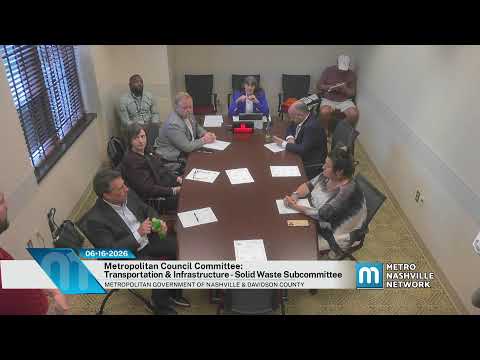
Subcommittee reviews proposed amendment, 5-year extension to Waste Management hauling contract
Summary
The Solid Waste Subcommittee heard details on BL 2026-1442, an amendment to Waste Management’s hauling contract to reflect a four-day schedule, consolidate pricing, add updated insurance and state-required language, and include a proposed five-year, $60 million extension; members pressed department staff on whether Metro could assume some routes and on full cost comparisons.
The Solid Waste Subcommittee reviewed BL 2026-1442 on first reading, an amendment to the county’s Waste Management collections contract that would formalize a four-day pickup schedule, consolidate multiple historical pricing rates into a single rate, update proof-of-insurance language and add a state-required Israel boycott clause.
Matt Purvis of Nashville Waste Services told the subcommittee the amendment also includes a proposed five-year extension that the department will send to council for consideration. "It’s a $60 million extension for an additional 60 months," Purvis said, and he confirmed the current Waste Management contract runs through 2027 and that Waste Management serves about 60% of curbside trash customers.
Why extend? Council member Franklin pressed the department on whether Metro should extend the contract if the city already has the capacity to take over routes. Purvis said that with existing staff and trucks Metro could assume nearly half of Waste Management’s roughly 24 daily routes and estimated that transition could reduce contractor costs by roughly $4–6 million annually (he described the contract’s total value at about $12 million a year). "We would feel pretty comfortable to take almost...half of those 24 routes a day," Purvis said, adding that the department would provide a cost-per-resident analysis that includes full employee costs (salary, fringe and pension).
Purvis said the amendment was submitted during negotiations tied to the four-day schedule and that the item will proceed through committee and to council; subcommittee members were told the Transportation Infrastructure and Budget committees will consider it and that council consideration is scheduled for the July 7 meeting. No final council vote occurred at the subcommittee meeting.
Members asked staff to produce more detailed, comparable cost figures before any decision on extensions or Metro assumption of routes. Franklin asked that any internal cost estimate include long-term employment costs so the analysis would reflect pension and fringe obligations rather than only private-sector line-item comparisons.
Next steps: BL 2026-1442 remains at first reading and will move to the relevant council committees; the department committed to provide the requested cost comparisons and additional details on how the amendment changes billing and service terms.