Get Full Government Meeting Transcripts, Videos, & Alerts Forever!
Get email alerts on the Student Programs topic
No spam. Unsubscribe anytime.
District highlights Project Tree growth, Special Olympics and adopts new behavior-intervention procedures
Summary
Administrators reported Project Tree enrollment rising from 106 to a projected 168 students with minority participation increasing to about 52%; the district also described a Special Olympics with 102 athletes and 19 coaches and secured board adoption of new behavior-intervention procedures aligned with state law.
Curriculum and student-support staff used the June 17 board meeting to report program outcomes and next steps.
Dr. Ashley Carlson summarized changes to Project Tree for the 2025–26 school year: elimination of the early start and bussing, placement of a full-time Project Tree teacher at Northeast, expanded single-subject and whole-grade acceleration pathways, and a growth in participating students from 106 (in 2021–22) to a projected 168 for 2026–27. Carlson said demographic participation has shifted: minority students are projected to represent about 52% of Project Tree participants in 2026–27, narrowing an earlier gap.
Student services reported that the district’s third annual Special Olympics, held May 26 at the Evergreen Park Sports Complex, featured 102 athletes and 19 coaches across five buildings. Administrators thanked volunteers and alumni participants who helped open the games.
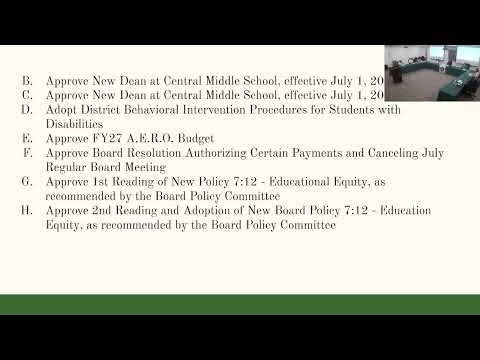
Separately, student-support staff outlined revised district behavioral intervention procedures required under Section 1408 of the Illinois School Code. The administration said the document addresses intervention types, criteria for behavior intervention plan review, allowable restrictive-intervention practices, staff professional development, and distribution procedures; the board subsequently adopted the procedures during the meeting and administrators said they will provide the document annually at IEP meetings.
Next steps: continue refining acceleration pathways and alternative core courses at Central Middle School, coordinate with the high school on increased enrollment, and distribute adopted behavior-intervention procedures to families at IEP meetings.