Get Full Government Meeting Transcripts, Videos, & Alerts Forever!
Get email alerts on the Land Use Reszone topic
No spam. Unsubscribe anytime.
Larimer County planning commission continues LifeQuest rezoning after water and comp-plan concerns
Summary
The Larimer County Planning Commission continued a June 17 public hearing on LifeQuest’s request to rezone roughly 235 acres to a Rural Plan Development, citing outstanding water-source and comprehensive-plan compatibility questions; the commission set a new hearing date of July 15, 2026 to allow the applicant to supply additional technical information and to encourage further review by referral agencies.
The Larimer County Planning Commission on June 17 continued, to July 15, a contested application from LifeQuest to rezone about 235 acres near Sunrise Ranch from Open to a Rural Plan Development (RPD). The applicant told the commission the project would be an integrated campus with clustered housing, resort lodging, program spaces and roughly 70% permanent open space; county staff and Loveland utilities officials warned the proposal could increase risks to Green Ridge Glade Reservoir and does not align with the county’s current comprehensive-plan framework for the area.
The application, filed as 25-ZONE-3797, would permit a mix of detached single-family and multifamily dwellings, resort lodging and program space under a customized RPD. Staff presenter Justin Curry said the county’s review finds the proposed uses and densities inconsistent with the mountain-foothills framework assigned to the parcels and that several referral agencies — most notably the City of Loveland Utilities — expressed significant concerns about water quality, on-site wastewater, runoff and potential nutrient loading into the reservoir. “Given its location in a rural part of the county, staff has concerns about feasibility to adequately service the proposal with public or private utilities,” Curry said during the presentation.
The applicant’s legal counsel, Claire Havalda, and project manager Meredith McKindle framed LifeQuest as a privately funded, clustered campus intended to deliver public benefits including workforce and senior housing, jobs and tourism spending. McKindle summarized the applicant’s projections: roughly $60–90 million in annual revenue range estimates, about 150 direct full‑time jobs, roughly $31 million in annual regional tourism spending and a broader $136 million regional economic impact (figures provided by the applicant). Engineer Matt Blakeley of TST presented technical materials the applicant says demonstrate feasible private water and wastewater systems (applicant cited access to Colorado-Big-Thompson water shares, an estimated treated-water need of about 83,000 gallons per day, a planned 400,000-gallon storage tank, and an expanded wastewater treatment plant sited to discharge north of the ridge rather than toward Loveland’s reservoir).
Public testimony split sharply. Dozens of supporters — many connected with Sunrise Ranch and Eden Valley — said the campus would bring jobs, internships, community programs and stewardship of open space. “This vision will create a campus community where people reconnect with the land and each other,” said Meredith McKindle. Opposing testimony focused on source-water protection: Todd Hanlin, the City of Loveland’s water resources manager, told commissioners that Green Ridge Glade Reservoir is Loveland’s primary drinking-water storage and that the reservoir’s proximity makes contamination risks especially consequential. “Any contaminants introduced into the reservoir have little to no travel time, leaving our opportunity to detect and intervene before reaching our drinking water system at risk,” Hanlin said.
Loveland’s utility staff and officials reiterated written comments in the planning packet that described concerns about on-site wastewater, increased stormwater runoff, nutrient enrichment and algal bloom risk, and periodic canal shutoffs and capacity constraints the city says could complicate a private water-supply reliance on Canal/CBT deliveries. Chad Bergenhire, Loveland’s water utility division manager, added that best management practices (BMPs) are mitigations but not substitutes for avoiding sources of risk near a municipal reservoir.
Applicants countered that the project’s clustered design and engineered stormwater measures would reduce phosphorus and sediment loads compared with current agricultural or unmanaged conditions, and that technical reports in the record (TST technical response) address the city’s comments. The project team offered to accept conditions tying future approvals to meeting the technical-report standards and to engage with Loveland and county staff during detailed design.
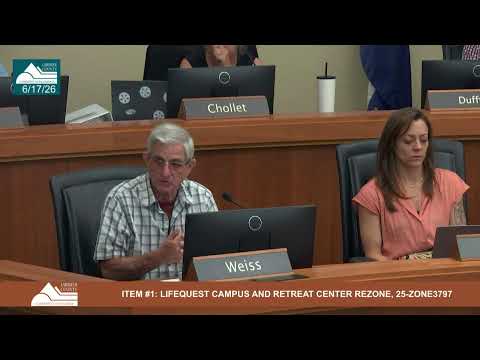
After deliberation, commissioners opted to continue the matter to give the applicant time to produce additional information and to allow staff, referral agencies and the applicant to pursue follow-up review and (if possible) technical reconciliation. Commissioner Duffy moved to continue to the July 15, 2026 Planning Commission meeting; the motion passed on a roll call vote recorded as yes from Duffy, Weiss, Slutzky, King and Chair Cholay.
Next steps: the hearing record will remain open to the extent permitted by local notice rules; the applicant said it will pursue additional technical meetings with staff and invited Loveland utilities to meet. The commission indicated it expects targeted, evidence-based responses to the outstanding water-quality and comprehensive-plan compatibility issues before the continuation date.