Get Full Government Meeting Transcripts, Videos, & Alerts Forever!
Get email alerts on the Sidewalks topic
No spam. Unsubscribe anytime.
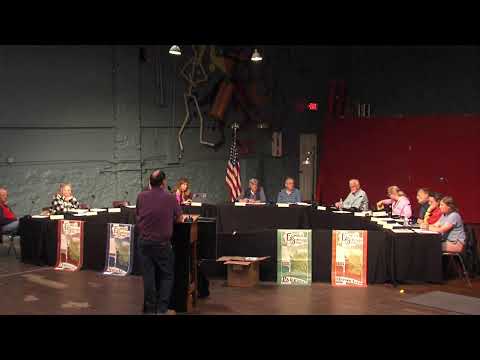
Eureka Springs officials debate repair thresholds and concrete specs in sidewalk ordinance workshop
Summary
At a joint Planning Commission–City Council workshop, officials reviewed a draft sidewalk ordinance that would require 3,500-psi mixes and a minimum ready‑mix delivery (3 cubic yards), and debated defining repair versus replacement thresholds, homeowner cost relief and vendor coordination.
A joint workshop of the Eureka Springs Planning Commission and City Council examined a draft sidewalk ordinance that proposes a 3,500‑psi concrete standard and would generally require ready‑mix truck deliveries for replacement work, but members pressed staff to clearly define small repairs that should not trigger that requirement.
Cassie Dishman, the city planning director, said the planning commission developed the draft “given the information of our building inspector” and that the commission will refine definitions of “repair” and “replacement” before returning recommendations to the council. Paul (staff member), who presented the technical recommendations, told the group that ready‑mix trucks provide controlled air entrainment and a consistent slump — qualities “you cannot get by mixing it out there on the ground” — which improve bonding and freeze‑thaw performance.
Several council and commission members said the technical standard risks imposing heavy costs on homeowners if even small patches require a three‑yard truck. Councilor Susan Groening urged the city to consider ways to reduce costs, including grouping nearby repairs to meet minimum truck loads or checking whether local suppliers can offer a discounted rate. “If we can get our maybe two suppliers that recognize the specs … have them both bid and say, ‘You are our preferred vendor to come into Eureka,’ ” Groening said.
Participants discussed concrete economics and scale. Speakers estimated a 3‑yard minimum covers roughly 240 square feet and cited a rough price of about $190 per cubic yard; commissioners calculated a 4‑by‑4 patch is a small fraction of a yard and argued that portable mixers or contractor‑performed patches should be allowed for small repairs. Several members suggested establishing a clear square‑foot threshold (examples raised included 4×4, 5×5 or up to 50 linear feet) below which a homeowner or approved contractor could use a portable mixer or perform a patch without arranging a full truck delivery.
The group also discussed enforcement and quality assurance. Commissioners asked how the 3,500‑psi requirement would be verified; Paul described common plant and contractor testing practices and noted that owners who later find failures could pursue a claim against the supplier. The meeting considered whether routine testing should be required up front (with an added testing cost) or handled reactively if a replaced sidewalk deteriorates.
Tree roots and site constraints drew separate attention. Members proposed case‑by‑case solutions — narrowed sidewalks, engineered permeable surfaces or rubber panels — decided by the building inspector, planning staff and, when needed, an arborist, to avoid unnecessary tree removal while keeping walkways safe.
On cost relief, the council asked staff to investigate legal constraints and options. Kathy (council member) noted city code (cited in discussion as Code 9.08.030) establishes that property owners are responsible for sidewalks abutting their property, and members asked for a legal opinion on whether the city can negotiate vendor discounts or solicit bids on behalf of property owners. The mayor and council asked staff to pursue a legal review and to contact local concrete plants to test interest in coordinated orders or discounts.
Staff reported a recent walk‑through identifying dozens of issues requiring attention: roughly 25 properties with immediate trip hazards, an additional 29 properties with trip hazards, and about 49 properties with missing concrete, underscoring near‑term maintenance needs.
Next steps: the planning commission will return with clarified definitions for repair versus replacement, a proposed minimum patch threshold, and recommendations on permitting and contractor requirements. Council members asked staff to obtain a legal opinion on procurement options and to explore whether grouped orders or vendor discounts are feasible. The workshop adjourned with those tasks assigned and no formal vote taken.