Get Full Government Meeting Transcripts, Videos, & Alerts Forever!
Get email alerts on the Budget topic
No spam. Unsubscribe anytime.
Middleton council hears budget plan calling for modest COLA, utility rate increases and capital prioritization
Summary
At a June 17 budget workshop, Middleton staff proposed a 4% budgetary COLA baseline, a 3% water-rate increase and a 10% sewer-rate increase for next year, and highlighted capital priorities including a new wastewater plant bond and water-reservoir planning. Council asked for more staffing cost detail before final decisions.
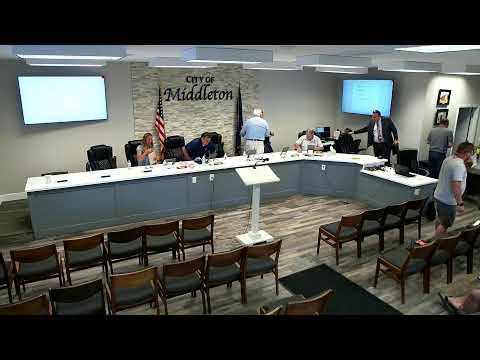
Middleton’s budget workshop on June 17 identified personnel and utility-rate choices the council must decide before adopting a tentative budget.
Wendy Smiles, the city’s finance lead, told the council that the city is budgeting conservatively and is projecting roughly 350 new home building permits for 2027—an assumption that helps justify revenue forecasts. Smiles said health insurance costs for the city are expected to rise about 12.5 percent next year and recommended the council give staff direction on an across-the-board cost-of-living adjustment; the staff-proposed baseline scenarios included a 4 percent COLA.
Public Works Director Jason Van Gilder presented the utility models that underpin several rate proposals. He recommended a 3 percent increase in water rates while projecting about 8 percent aggregate revenue growth once new-connection fees and new customers are included. For sewer, Van Gilder recommended a 10 percent increase next year, citing debt-service needs tied to the city’s wastewater treatment plant project and the financing plan under discussion.
Van Gilder said the wastewater program still faces uncertainties tied to the final construction bids and permitting (staff expects a key bid opening on June 25), but that the rate increases are intended to move the city toward a long-term target so bond debt service will be covered by stable rate revenue rather than one-time connection fees. Staff used a planning assumption of a roughly $33 million second bond for the new plant when modeling multi-year debt service.
On staffing, Chief Smith described a proposal to add supervisory capacity in the police department (promote a lieutenant-level position and reallocate sergeant duties) so patrol officers can spend more time in the field. Council members asked for detailed job descriptions, fully burdened cost estimates and an explanation of how new hires would be funded if building-permit revenues declined. Smiles reiterated the city’s conservative budgeting approach and cautioned that ongoing personnel costs must not be paid from one-time revenues.
Other capital priorities discussed: water-reservoir planning and a redundant supply line to reduce single-point failures in the distribution system; pavement maintenance and roundabout/sidewalk projects for streets; and park maintenance and Riverwalk planning (the latter contingent on final gravel-lease arrangements). Staff flagged that high-cost projects such as a new reservoir or a city hall campus would rapidly deplete reserves and likely require bond financing or multi-year savings plans.
Council did not make final funding commitments at the workshop. They directed staff to return with more detailed job descriptions, cost breakdowns for proposed new positions, and updated revenue figures after the county provides the property-tax roll on July 20. The tentative budget adoption and public hearing schedule remains on the staff timeline for August.