Get Full Government Meeting Transcripts, Videos, & Alerts Forever!
Get email alerts on the Rezoning Pleasant Hill topic
No spam. Unsubscribe anytime.
Knox County commissioners deny 12‑unit‑an‑acre rezoning for Pleasant Hill Road, ask mayor’s office for vision plan
Summary
After hours of public comment and questioning about traffic and school impacts, Knox County commissioners voted to deny a developer’s request to rezone 16 acres on Pleasant Hill Road for up to 12 dwelling units per acre and asked the mayor's office to initiate a neighborhood vision plan.
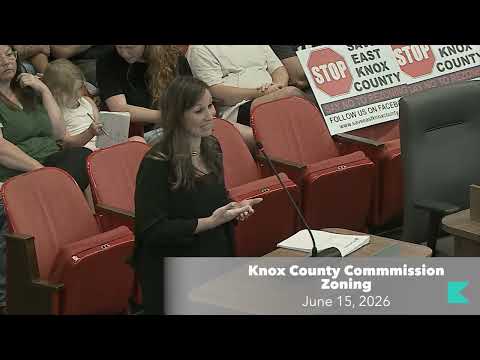
Commissioners on the Knox County Commission voted to deny a rezoning request that would have allowed up to 12 dwelling units per acre on a 16-acre parcel at 8934 Pleasant Hill Road, concluding a contentious public hearing that drew hundreds of written comments and testimony from community members.
The decision came after developers and planning staff sparred with residents and commissioners over whether the property is ready for high-density development. Thomas Kruzynski, speaking for Homestead Land Holdings, told commissioners that a higher residential density would help attract the grocery and other commercial uses recommended in the county's town‑center planning, and that the parcel sits near signalized intersections and existing infrastructure.
Neighbors, community groups and residents including speaker Chris Howard and others presented petitions and comments opposing the rezoning. "We strongly feel that this is about 10 years too early," Howard said, arguing the parcel lacks the walkable mixed uses and plan components necessary for a true town center and that placing dense housing on the site would preclude later commercial development. Several residents raised safety concerns about sight distances and pedestrian access near local schools.
Planning staff recommended denial, citing substandard road conditions and stormwater constraints; Planning Commission had agreed to conditions but recommended approval. Commissioners debated whether to defer to allow a neighborhood visioning process. Commissioner Adam Thompson moved to deny the rezoning and to ask the mayor's office to coordinate a community vision plan for the Carter town‑center area; Commissioner Rawls seconded the motion. The denial motion, which also included the request to initiate vision planning, passed 8–2 with two abstentions and one commissioner absent.
The commission's action leaves the property in its current agricultural zoning. Commissioners who supported the denial said the area needs a public, community‑driven vision before upzoning the larger parcels in the corridor. Supporters of development said the area is already changing and that rooftops are being approved nearby, arguing that some additional housing will help attract the shops and services the community seeks.
What happens next: the mayor's office and Knox Planning will be asked to coordinate a neighborhood vision study; any future zoning application on the site would likely be considered in light of that plan. No new construction approvals may be advanced under the denied zoning as presented; alternative proposals materially different from the one voted down could be refiled in a form the commission deems substantially different.