Get Full Government Meeting Transcripts, Videos, & Alerts Forever!
Get email alerts on the Data Center Project Blue Stem topic
No spam. Unsubscribe anytime.
Leavenworth County approves Call Valley development agreement after hours of public opposition to proposed 'Project Blue Stem' data center
Summary
The Leavenworth County Board conditionally approved a special-use permit and a development-and-road agreement for Call Valley's sand-excavation project while receiving extensive public comment opposing a proposed hyperscale data center (dubbed Project Blue Stem) over water, noise, health and tax concerns. Staff presented a tax-impact estimate; the applicant pledged to work on rail access.
The Leavenworth County Board of Commissioners voted to move forward with a conditional special-use permit and a development and road-improvement agreement with Call Valley Inc., advancing a sand-excavation operation tied to the broader Project Blue Stem proposals while also hearing hours of public opposition to a separate proposed hyperscale data center.
The board’s action followed staff and counsel briefings and public testimony. County counsel confirmed minor drafting fixes to Resolution 2026-7 and told the board the language as written reflected the commission’s previous motion on dredging and related operations. County staff outlined the proposed development-and-road agreement that would require a third-party engineering review, pre- and post-construction roadway repairs, a royalty structure for hauled sand and a dispute-resolution process.
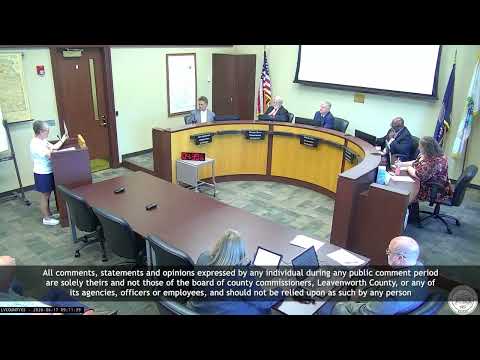
The meeting was dominated by public comment about a proposed hyperscale data center being marketed in the area as Project Blue Stem. Dozens of residents warned of long-term environmental and public-health risks and urged the commission to set stricter, enforceable local standards or to deny facilitation. "Once contamination occurs, cleanup is extremely difficult and often cases cost millions," said Jim Carl Kent during the public-comment period, urging commissioners to hear independent industrial-hygienist experts rather than only developer presentations. Kim Calbert, who identified technical noise-modeling concerns, pressed the board not to adopt human-workplace noise standards for 24/7 residential exposure and said, "If we don't choose the regulations to protect that, then we're not serving the people who have to live with this."
County staff presented a conservative, staff‑reviewed estimate for a 1 million-square-foot data facility to illustrate fiscal effects. "A million square foot building would generate roughly ... $14 million per year in taxes" across all local taxing entities, staff said; the analysis allocated roughly $3.8 million to county operations and about $6.3 million to local school districts in the model provided (staff noted valuations and buildout timing are assumptions and that a 3 million-square-foot buildout would triple those amounts). Staff also estimated pre-construction and intermittent repairs and one-time construction impacts that could approach mid‑eight figures (staff identified a $13.5 million potential one‑time construction‑related road-repair package and a $600,000 traffic/wastewater study estimate).
Applicants’ representatives told the commission they would participate in county planning efforts. "We gladly participate and help to expedite that approval," said Aaron March on behalf of Call Valley when asked whether the company would join a working group to pursue a rail spur intended to reduce truck traffic.
Several commissioners said they remained concerned about parts of the proposals. One commissioner said he would maintain a previous no vote on the resolution; others said they supported placing protections in the development agreement. The transcript records motions and seconds to approve both Resolution 2026‑7 and the development-and-road agreement; a full roll-call tally did not appear in the excerpt of the public record.
Next steps identified by staff include completing required studies (traffic/wastewater), finalizing road-improvement estimates, negotiating specific development-agreement terms to protect county revenue if taxable values fall, and establishing terms for a community-impact fund to help offset local infrastructure stressors during construction. Commissioners also discussed whether to require an impact-payment mechanism should taxable value decline in the future and whether pre-funded community benefits would be part of any final agreement.
The meeting closed after additional public comments about local impacts and heated exchanges in the audience; the chair repeatedly emphasized civility and warned that disruptive behavior would not be tolerated.
The county’s packet and the draft development agreement are available from county staff; the applicant and several citizens asked the board for further engagement on technical issues, including noise modeling, water protections and long-term monitoring commitments.