Get Full Government Meeting Transcripts, Videos, & Alerts Forever!
Get email alerts on the Seabed Minerals Leasing topic
No spam. Unsubscribe anytime.
BOEM details environmental review, surveys and next steps for potential seabed mineral leasing offshore American Samoa
Summary
The Bureau of Ocean Energy Management said an Area Identification for potential non‑energy seabed mineral leasing offshore American Samoa was published Nov. 10, 2025; BOEM is preparing an Environmental Assessment, coordinating statutory consultations, and running NOAA/USGS mapping and targeted studies before any lease decision.
Natalie Dial, leasing coordinator for the Bureau of Ocean Energy Management (BOEM) Pacific OCS region, presented an update on BOEM’s early‑stage process to evaluate potential non‑energy seabed mineral leasing offshore American Samoa.
Dial said BOEM published an Area Identification (Area ID) on Nov. 10, 2025, which defines broad areas undergoing environmental analysis and is not a decision to lease. She said the Area ID followed a Request for Information and Interest (RFI) published June 16, 2025, that opened a 30‑day public comment period later extended 30 days at the request of the Governor of American Samoa.
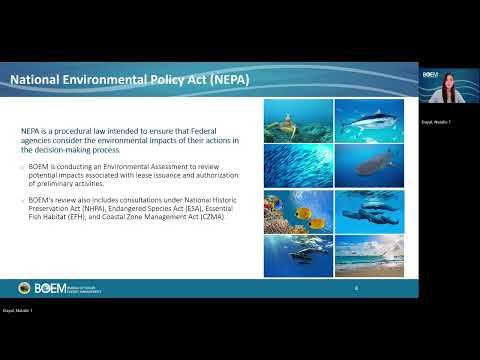
The presentation stressed that BOEM is preparing an Environmental Assessment (EA) under the National Environmental Policy Act (NEPA) to evaluate potential impacts of issuing a lease and authorizing preliminary activities, such as seabed surveys and testing. Dial said the NEPA review will include consultations required by other federal laws, including the National Historic Preservation Act, the Endangered Species Act, Essential Fish Habitat provisions and the Coastal Zone Management Act.
BOEM described the kinds of mineral deposits under consideration — primarily polymetallic nodules (found on abyssal plains roughly 3,500–6,000 meters deep) and cobalt‑rich ferromanganese crusts (on seamounts and ridges from roughly 400–7,000 meters) — and said these can contain nickel, cobalt, lithium, manganese and rare earth elements that are important to U.S. energy, technology, manufacturing and defense supply chains.
Dial outlined a suite of ongoing and planned scientific studies BOEM is relying on to inform the EA. She said NOAA and USGS partnered on a NOAA‑funded multibeam mapping, AUV imaging and box‑coring survey offshore American Samoa; fieldwork is complete and data processing is underway. Dial said USGS returned nodules for compositional analysis and that NOAA’s Office of Coast Survey conducted a three‑month hydrographic survey in January 2026 to map more than 30,000 square nautical miles of federal waters in the region. She said NOAA Ocean Exploration and the NOAA Ship Okeanos Explorer will conduct deepwater ROV surveys later in the summer to collect imagery and baseline data.
BOEM also highlighted targeted studies including a socio‑economic analysis of Pacific Island fisheries to inform impact assessments and a recently awarded project called Tuna CHAMP to study how seabed‑mining plumes might affect tuna, their prey and seafood safety through telemetry, ecology and contaminant analysis. Dial said BOEM plans pilot efforts to study sediment plumes, expanded sea‑turtle distribution tagging with NOAA Fisheries, and a Maritime Heritage Study to synthesize archival and archaeological information relevant to submerged and terrestrial cultural resources.
On procedural timing, Dial said that if BOEM decides to proceed after Area ID and the EA, staff would publish a Proposed Leasing Notice in the Federal Register describing proposed lease terms, payment stipulations and bidding procedures, and would consider comments from the Governor of American Samoa before issuing a Final Leasing Notice and, if appropriate, holding a competitive lease sale. She emphasized that lessees must submit delineation, testing and mining plans and receive BOEM approval before conducting those activities.
"Area ID is not a decision to lease, but rather a planning step that ensures further decisions are grounded in environmental analysis and intergovernmental coordination," Dial said. "We welcome your perspectives as we move into these next steps."
BOEM said the next milestones are completion of the environmental analysis and issuance of a Proposed Leasing Notice; it will continue coordination with the Government of American Samoa and the Deep Sea Minerals Steering Committee and invited stakeholders to review posted materials on BOEM’s American Samoa webpage and to submit input.