Get Full Government Meeting Transcripts, Videos, & Alerts Forever!
Get email alerts on the Trees Qzone Redway topic
No spam. Unsubscribe anytime.
Humboldt County commission denies permit to remove large old‑growth redwood in Lower Redway
Summary
After hours of expert testimony and more than 100 public comments, the Humboldt County Planning Commission voted to deny a special permit sought by property owner Robert Scarlet to remove a 252‑foot, 118‑inch‑diameter old‑growth redwood in Lower Redway, finding the applicant did not meet the ordinance’s standard that the tree is an “immediate hazard.” The denial follows community objections, competing arborist assessments and questions about earlier removals on the property.
The Humboldt County Planning Commission voted to deny a special permit requested by property owner Robert Scarlet to remove a large old‑growth redwood in Lower Redway, concluding the applicant had not demonstrated the tree posed an imminent hazard.
Cliff Johnson, planning staff presenting the application, described the tree as “252 feet tall, 118 inches in diameter and ... estimated to be more than 350 years old,” and summarized reports from a registered professional forester, a certified arborist and a CalFire inspection that found structural defects and root impacts raising the tree’s risk profile. The tree sits in the county’s Lower Redway Q zone, an overlay that requires discretionary review for removal of mature redwoods.
Why it matters: the Q‑zone was created to protect old‑growth redwoods and to require public review before removal. Residents and conservation groups told the commission that approving removal would set a precedent that could accelerate loss of irreplaceable trees; opponents also raised concerns about the county’s handling of four trees that were removed earlier on the same parcel. Staff and several experts urged the commission to weigh the narrow public‑safety claim against broader community and ecological values.
Staff and applicant case Cliff Johnson told commissioners that the application included reports from a CalFire‑registered professional forester, an RPF and a certified arborist who identified a cavity within the upper bole, trunk scarring, and root system impairment at the base — findings Johnson said support the “immediate hazard” category in Ordinance 2112 only if the commission finds the hazard likely to cause failure in the foreseeable future. He explained staff’s recommendation and presented three procedural options: approve with conditions, approve with additional conditions (for example, delaying removal until after the marbled murrelet nesting season), or deny.
Attorney Tanya Farmer, representing applicant Robert Scarlet, urged approval and summarized the applicant’s expert evidence, saying CalFire and the applicant’s consultants documented structural defects and a public‑safety risk. Farmer argued the record supported the permit, noting in presentation that the experts concluded the tree posed a threat to “residences, power lines, roads, people” and that the applicant had followed the permitting advice he received.
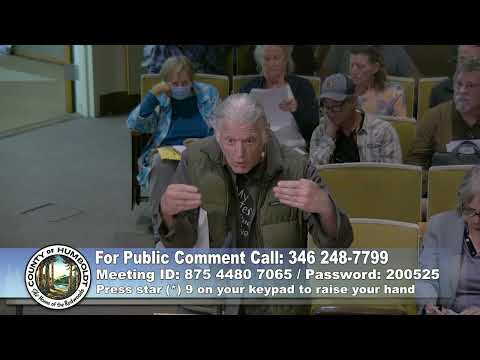
Community objections and competing expert opinions More than a dozen residents and several professional foresters or arborists spoke against removal. Tom Wheeler, executive director of the Environmental Protection Information Center (Epic), told the commission that some defects identified in reports were caused or magnified by actions on the property and cautioned against reading future rot into a cut made previously by the owner’s contractors.
Multiple commenters who are professional foresters or long‑time residents disputed the applicant’s evidence and said the tree appears healthy and not in imminent danger; several urged the commission to require less‑destructive alternatives, such as targeted limb removal or canopy reduction. Nate Madson of Epic summed up a frequent appeal from the public: “Just say no.”
County procedural and habitat concerns California Department of Fish and Wildlife (CDFW) submitted comments noting the area’s high‑quality habitat and suggesting, if removal were permitted, a condition delaying work until after marbled murrelet nesting season (September 15). Staff said it had discussed mitigation with California State Parks and proposed a condition to offer the trunk to State Parks for cultural and habitat uses if removal were approved; staff did not include a nesting‑season delay in its primary recommendation because it treated the immediate hazard claim as potentially outweighing that timing condition.
Deliberation and vote Commissioners focused on the burden of proof for “imminent danger” under the Q‑zone ordinance and on gaps in the evidentiary record: several public commenters submitted letters from additional arborists and foresters questioning the applicant’s reports; the commission noted that some of those opposing experts had not performed detailed on‑site testing but had provided visual assessments that conflicted with the applicant’s consultants. Commissioners also discussed the county’s prior handling of four trees on the same parcel and whether process errors had occurred.
After discussion the commission adopted a motion to deny the special permit, finding the applicant had not adequately demonstrated that the tree meets the Q‑zone’s “immediate hazard” standard. The motion carried on roll call.
Next steps and procedural notes Denied permits do not permanently bar an applicant from returning with new evidence; commissioners and staff said the property owner could reapply if more compelling, independent analyses are produced. Commissioners also directed staff to return with proposed refinements to the Lower Redway Q‑zone language and procedures (for example, clearer definitions of “imminent hazard,” notice to all properties in the Q zone, standards for expert evidence and mitigation steps such as targeted limbing).
The decision concluded a multi‑hour hearing in which hundreds of pages of expert reports and public comments were entered into the record. The commission adjourned and scheduled its next meeting for July 16, 2026.