Get Full Government Meeting Transcripts, Videos, & Alerts Forever!
Get email alerts on the Forest Management topic
No spam. Unsubscribe anytime.
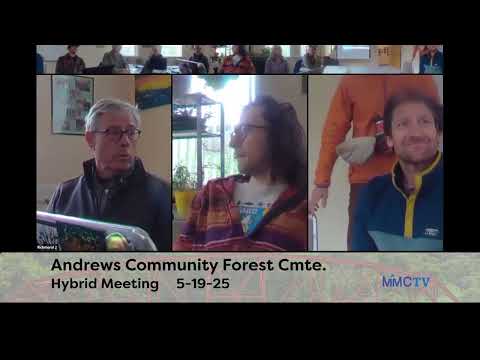
Richmond forest committee agrees to send progress memo to Select Board, starts with recreation review
Summary
At its meeting, the Andrews Community Forest Committee debated whether to send an in‑progress draft of the management plan to the Select Board, agreed to send a cover memo with selected materials, prioritized review of the recreation section while anchoring decisions to ecological standards, and formed a small working group to finalize materials ahead of a June 2 packet.
The Andrews Community Forest Committee met and agreed to provide the Select Board a brief cover memo and selected materials showing progress on the town forest management plan rather than sending an incomplete, unvetted draft for approval.
The move followed a lengthy discussion in which the committee weighed whether to comply with a Select Board request for a draft by June 2 or to ask for more time. The committee’s co-chair warned that “a failure to comply would have a terrible impact on our committee’s credibility,” and members landed on sending a short explanatory memo plus representative documents to show substantial progress while seeking more time for a refined draft.
Why it matters: committee members said the ecological section of the plan must provide the foundation for recreation decisions. A member of the public urged the group to “clarify the ecological section of the management plan before we finalize the recreation decisions,” highlighting a 330‑foot buffer cited from regional research as an example of the kind of science‑based guidance the committee needs.
What the committee decided: by consensus the group will: - Prioritize reviewing and consolidating multiple recreation proposals during the next meetings while ensuring recreation rules follow ecological parameters; members agreed to start work on the recreation section first and to use ecological buffers and a separate set of trail‑development parameters to resolve conflicts. - Prepare a short cover memo for the Select Board that summarizes progress, lists key outstanding issues, and attaches select supporting materials rather than sending all appendices and every draft version. - Form a small working subgroup (co‑chairs plus volunteers) to combine the recreation drafts with ecological parameters and produce a revised recreation section and cover memo for the June 2 Select Board packet; the committee scheduled a follow‑up meeting on June 2, 6–8 p.m., to advance that work.
Debate and technical points: discussion focused on precise words, scope and monitoring rather than high‑level goals. Members debated terms such as “wildlife corridor” versus “passages,” the exact buffer distances to protect vernal pools and oak stands, and whether parts of the existing “Vast” trail or power‑line corridor could serve as multi‑use or mountain‑bike access. Several members proposed an adaptive approach: open some lower trails to multi‑use now, designate more sensitive northerly areas pedestrian‑only initially, adopt baseline ecological monitoring, and revisit multi‑use permissions if monitoring shows no unacceptable impacts.
On enforcement and monitoring: the committee discussed using simple monitoring tools (trail counters, camera traps, scheduled site checks) and seeking modest funding — for example from the town’s conservation reserve — to establish baseline data and pay for seasonal monitoring before authorizing any new multi‑use trails above sensitive zones.
Votes and formal actions: the committee approved routine housekeeping motions during the meeting. It accepted the April 28 minutes (motion moved by Jimmy, seconded by Brad; recorded as unanimous among the six members present). Members also moved to formally thank three departing volunteers for their service and approved installation of a permanent sign‑in sheet at the trail kiosk.
What’s next: a small drafting subgroup will produce the cover memo and an integrated recreation draft that references the ecological parameters and monitoring plan; the committee will reconvene June 2 (6–8 p.m.) to finalize what goes to the Select Board. The committee discussed aiming for a refined draft to the Select Board by late summer (August–September) after additional reviews by the trails committee, the conservation commission, public comment, and other stakeholders.
Votes at a glance: - Motion to accept the April 28 minutes: moved by Jimmy; seconded by Brad; outcome: approved, unanimous among six members present. - Motion to thank departing members for service: moved (recorded in meeting); outcome: approved (unanimous/consensus recorded). - Motion to mount a permanent sign‑in sheet at the trail kiosk: moved and seconded; outcome: approved.
Context and constraints: committee members repeatedly cautioned that the ecological section — including buffers for sensitive natural communities and vernal pools — must drive trail siting and allowable uses. They emphasized the management plan is a living document: where monitoring shows impacts, management actions would follow. Several members also urged simplicity in the recreation section (a short guiding document) with detailed technical parameters placed in an appendix or a separate trail‑development parameters document.
The committee recorded next steps: the co‑chairs and volunteers will draft the cover memo and consolidated recreation text for the June 2 packet; the full committee will meet June 2 (6–8 p.m.) to review the materials before the Select Board meeting.