Get Full Government Meeting Transcripts, Videos, & Alerts Forever!
Get email alerts on the Zoning topic
No spam. Unsubscribe anytime.
Town board reviews zoning ordinance updates, cites Indiana Code for public-notice language
Summary
The town board read proposed zoning ordinance updates, discussed referencing Indiana Code 5-31-2 for meeting notices, and debated special-exception rules, R1/R2 distinctions, and application fees while considering online application tools.
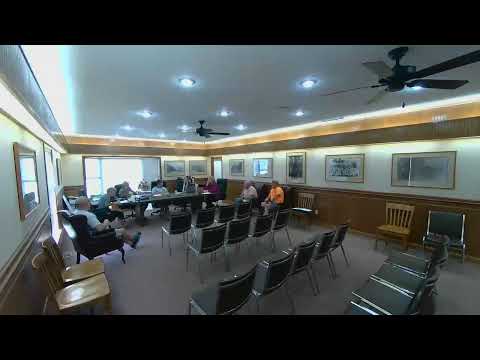
The town board met to review proposed changes to local zoning and ordinance language, focusing on public-notice rules, special exceptions and application fees. The chair opened the session and led the Pledge of Allegiance before members began a line-by-line review of the zoning sections.
A staff member who is handling the draft said the notice language in the draft should probably point to state law to avoid future mismatch. "It might make more sense to just reference that state statute in there," the staff member said, adding that the requirement to publish at least once and at least 10 days before a meeting aligns with Indiana Code 5-31-2. The clerk confirmed local practice for publication and lobby posting.
Board members discussed how to treat new topics such as special exceptions (section 156.168) and the role of the zoning inspector. The staff member explained that special exceptions and variances are the mechanisms for allowing uses that are not otherwise permitted in a district and that the plan commission makes advisory recommendations while the board of appeals (BZA/BCA) may have final authority in some cases. On allowable uses and transitions between R1 and R2 zoning, the staff member noted that some older properties are "prior non-conforming uses" and can remain until they change, at which time a variance or rezoning may be required.
The board also discussed application fees. The staff member recommended tiered fees to cover administrative costs and to deter frivolous filings: "Some of those things require more charge more things," the staff member said, recommending different fees for simple variances versus major development plans. Members asked staff to survey neighboring municipalities for typical fee levels.
To reduce front-office workload, members proposed adding online application options and a QR code on public materials so applicants can find forms directly. The meeting closed the ordinance discussion with staff agreeing to do further research on statutory citations, fee structures and drafting language for special exceptions and lot standards.
The board made a motion near the end of the session and took a voice vote to adjourn.