Get Full Government Meeting Transcripts, Videos, & Alerts Forever!
Get email alerts on the Transportation topic
No spam. Unsubscribe anytime.
Select Board accepts Cochran Road scoping study, asks staff to pursue short-term safety steps
Summary
The Richmond Select Board accepted a corridor scoping study for Cochran Road on May 19 and directed staff to begin lower-cost safety measures — including 35-mph transition zones, new signage and pavement markings — while pursuing longer-term improvements that could cost millions.
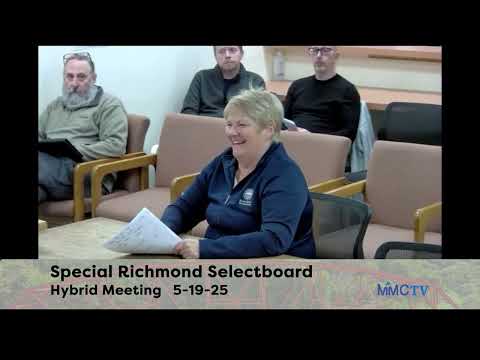
The Richmond Select Board voted May 19 to accept the Cochran Road Corridor and Scoping Study and begin implementing lower-cost safety measures while keeping larger engineering options on the table.
Keith Oborn, Richmond irector of planning and zoning, introduced the final study and said engineers provided a menu of options with cost estimates. Engineer Eric Maki told the board the corridor is constrained by ledge, utility poles and floodplain in places and that full-build improvements (sidewalks in village areas, paved shoulders in the 45-mph rural segment) could run into the millions. "We understand that a lot of these items are too expensive," Maki said, and presented shorter-term alternatives.
Saar (Sai) Philly, senior transportation planning engineer at the Chittenden County Regional Planning Commission, presented speed and crash data collected by automated recorders. He recommended the board consider a 35-mph transition zone between existing 45-mph and 25-mph areas, additional curve and wayfinding signs, and new bicycle clearance signage to increase driver awareness: "A transition zone helps drivers identify that they are entering a village setting," he said.
Board members and residents emphasized the tradeoff between aspirational projects and what the town can afford now. One resident described frequent high-speed traffic and urged active measures at the Huntington Road/Cochran Road intersection; board members and staff noted that while permanent paved shoulders are desirable, the town is more likely to start with signage, pavement markings and selective speed-calming devices.
The board unanimously approved a motion to accept the study and asked staff to return with a prioritized, costed list of near-term actions for implementation and a plan for community engagement. The next steps identified by staff include drafting a traffic ordinance change to enable 35-mph transition zones and presenting specific short-term investments at a follow-up meeting.