Get Full Government Meeting Transcripts, Videos, & Alerts Forever!
Get email alerts on the Cannabis Regulation topic
No spam. Unsubscribe anytime.
Council debates local cannabis regulatory framework and directs staff to draft ordinance
Summary
Council reviewed the state Office of Cannabis Management guide and discussed whether to operate a municipal cannabis business, how many retail licenses to allow, buffer distances from schools/parks/daycare, permitted zoning, and hours of sale; staff will draft an ordinance for future review.
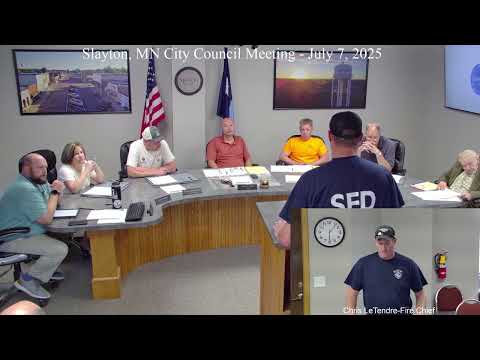
Slayton’s City Council spent the bulk of its meeting discussing how the city should regulate cannabis businesses under the state Office of Cannabis Management framework and asked staff to draft a municipal ordinance for council review.
A staff presenter opened the discussion with the state model materials and a summary of local options, telling the council that state law requires permitting at least one retail cannabis license per jurisdiction (one per 12,500 residents) but allows municipalities to set local limits and parameters. The presenter said local choices include whether the city itself should operate a municipal cannabis business and whether to allow additional private retail licenses beyond the state-minimum allowance.
Council members and staff focused on buffer distances and zoning. The presenter explained the common configurations: a 1,000-foot buffer from schools and a 500-foot buffer from parks and daycare facilities would be consistent with the higher end of state options; retail use could be limited to business and highway-commercial districts (B1/B2) rather than industrial-only zones, while heavier uses such as cultivation and processing would more naturally sit in industrial districts. The presenter summarized: "you have to allow one every 12,500," and added that the city cannot adopt a more stringent statewide requirement (for example, it cannot require a 2,000-foot school buffer where state law sets smaller maxima).
Members discussed whether the city should create a municipal-owned retail business, noting potential revenue upside and political downsides. One council member raised insurance and federal-risk concerns: the League of Minnesota Cities insurance trust currently does not insure municipally operated THC dispensaries, and speakers warned of possible complications for federal funding (for example, FEMA) if the city directly ran a cannabis retail operation.
Licensing timing and process also drew attention. Staff noted that the state’s licensing process includes pre-application and application windows and a retail license lottery planned for late July; several nearby jurisdictions are already processing applications. Council members urged staff to prepare a draft ordinance quickly because license applicants might be drawn in the state lottery before the city finalizes its local regulatory decision.
On operating hours, the council discussed default state-allowed hours (8 a.m. to 2 a.m.) and local restrictions. Several members favored a simpler, more restrictive local limit—such as 10 a.m. to 10 p.m.—to align with liquor-sale hours and reduce late-night activity.
The council requested additional material (comparative liquor setbacks, a map overlay of buffers within Slayton, and sample ordinance language used by nearby cities) and directed staff to prepare a draft ordinance reflecting the council’s guidance for a future public hearing and adoption process.
Next steps: staff will prepare the draft ordinance and present it to council for review and scheduling of the legislative process.