Get Full Government Meeting Transcripts, Videos, & Alerts Forever!
Get email alerts on the Master Utility Study topic
No spam. Unsubscribe anytime.
Elnora holds public hearing on master utilities study; residents raise brown-water concerns
Summary
At a June 9 public hearing, Elnora officials outlined a $100,000 master utilities study (seeking a $90,000 grant and $10,000 local match), presented options and cost estimates for water, wastewater and stormwater upgrades, and heard resident concerns about brown drinking water.
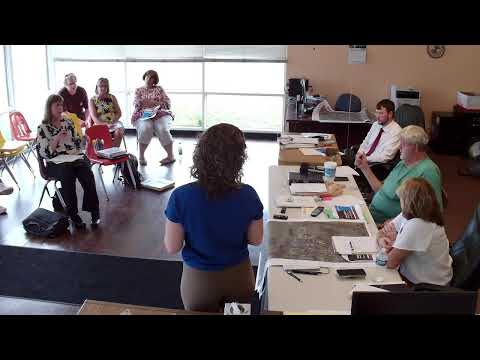
Elnora held a public hearing June 9 to review a master utilities study for the town’s water, wastewater and stormwater systems and to solicit public comment on funding and project priorities.
The meeting, announced in compliance with Indiana Code 5-31, presented a draft study estimating the master-utility planning cost at $100,000; the town is seeking a $90,000 grant with a $10,000 local match, the clerk said. Lauren Young, an engineer on the study team, said the study’s purpose was to assess current conditions, project 20-year needs and present alternatives and cost estimates.
Young said Elnora currently operates two water supply wells and that the treatment system has substantially more capacity than the town’s present usage. “We have two water supply wells. We have 360,000 gallons per day treatment capacity,” Young said, and she reported that average daily use in 2025 was about 7,000 gallons. The study authors recommended routine meter replacement and mapping updates to improve billing and loss reduction.
The study identified operational vulnerabilities in controls and monitoring. Young noted the town’s supervisory controls (SCADA) and some components run on unsupported software, saying the system was “outdated” and that upgrades to automatic controls and remote monitoring were among the major needs.
Engineers outlined several options for replacing filter media at the water plant and supplied three vendor price points. Lower-cost bids to remove and install new media were reported in the $39,000–$49,000 range, while a higher-end option appeared near $150,000. The study team presented a construction estimate near $190,000 that, after a 20% contingency, would bring construction costs to roughly $230,000 and total project costs to about $240,000 including engineering.
Officials described funding paths tied to project size. Staff said certain national programs typically cover projects under roughly $266,000, which can keep the town from pursuing longer-term bonding options that add cost.
On wastewater, planners described an older treatment plant, about seven miles of collection lines and roughly 138 manholes; recommendations emphasized improved process control, remote alarms and maintenance to reduce bypass risk. The team said the town is positioned to seek State Revolving Fund (SRF) assistance, possibly in a later application round.
For stormwater, the study mapped an approximately eight-mile network of roadside ditches and 109 storm pipes and suggested establishing a stormwater utility to generate predictable local revenue for maintenance and to improve grant competitiveness. The consultants discussed a minimum fee of about $5 per month per utility account as a baseline that many grant programs look for; they also gave a planning-level cost estimate for recommended stormwater alternatives at about $1.2 million.
During the public-comment portion, resident Kimberly Hardy said she was worried about drinking-water appearance and safety: “If it’s brown, that is—that’s very alarming,” she said, and asked who performs water testing and how the town would assure safety for schools and elderly residents. Town staff and the presenters said testing and reporting are routine but did not record a new testing schedule or immediate operational change on the hearing record.
No formal vote was taken during the hearing. Town staff indicated the study’s recommendations are intended to inform capital-planning and future grant applications; the presenters noted that pursuing SRF or other grant rounds could occur in 2027 depending on town priorities. The clerk closed the public hearing at 6:16 p.m. and invited any further written comments to be submitted to town staff.
The study and the draft cost estimates will be available to town leaders as they weigh which projects to prioritize and which funding channels to pursue.