Get Full Government Meeting Transcripts, Videos, & Alerts Forever!
Get email alerts on the Historic Preservation topic
No spam. Unsubscribe anytime.
Urbana preservation commission reviews Section 106 process as SHPO finds Civic Center eligible; MTD and community debate reuse vs. demolition
Summary
At a Feb. 18 special study session, Urbana officials and community members reviewed the Section 106/NEPA process for a proposed MTD downtown transfer center at the Urbana Civic Center. SHPO found the building National Register-eligible and the MOA requires HABS documentation; MTD says the building footprint complicates bus circulation and some alteration may be needed. Commissioners scheduled follow-up work and were urged to explore adaptive reuse and local landmarking.
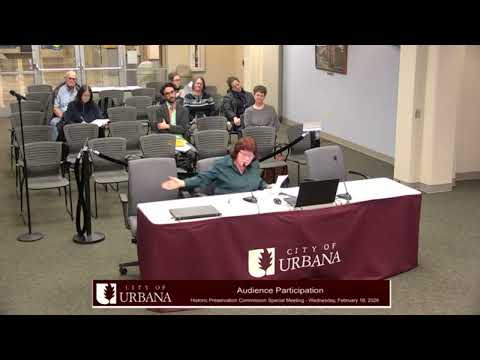
The Urbana Historic Preservation Commission met in a special study session on Feb. 18 to review the Section 106 and NEPA process connected to the Mass Transit District92s proposed downtown transfer center at the Urbana Civic Center (108 East Water Street).
City staff walked commissioners and the public through a timeline of decisions: the Civic Center was closed in 2018, listed in the city92s CIP as a demolition candidate in 2025, and later became the subject of an FTA-led NEPA review. In January 2025 the FTA92s cultural resources report initially found no adverse effect, but the State Historic Preservation Officer (SHPO) disagreed, determining the Urbana Civic Center is eligible for the National Register under Criterion A (community/reccreation) and Criterion C (modernist design), and that the proposed project could have adverse effects.
"SHPO determined that the Urbana Civic Center is in fact National Register of Historic Places eligible under criterion A ... and criterion C," staff told the commission, summarizing SHPO92s written finding.
The commission was also told an MOA between FTA, SHPO and MTD was signed in late 2025 and transmitted to the Advisory Council on Historic Preservation; the MOA requires prescribed mitigation. Staff said the mitigation includes contracting a qualified professional to document the Civic Center to HABS (Historic American Buildings Survey) level 3 and submitting that documentation to SHPO before any demolition could proceed.
The public and commissioners pressed for more transparency about the process and earlier communication. Commissioners asked for a copy of a February city letter that had agreed with FTA92s initial no-adverse-effect determination and questioned whether HPC had been consulted before that letter was issued. Staff agreed to provide the letter and acknowledged turnover and communication lapses in city staffing had complicated outreach to the commission.
"We can certainly provide that," staff said when commissioners requested the letter, while acknowledging that there was a period of staff turnover that likely led to lapses in communication.
A UIUC design studio led by Professor Joseph Altschuler presented student concepts that explored adaptive reuse, additions and strategic removals to create transit and civic functions. Altschuler described the studio92s approach as intentionally speculative, noting that MTD had said adaptive reuse "was not the primary" goal but that students were asked to imagine civic possibilities.
"The work I92m going to share with you tonight is one example of that," Professor Altschuler told the commission, summarizing the students92 projects that ranged from building additions to partial-envelope reconfigurations and public-realm activation.
MTD92s representative, Ashley McLaughlin, said the agency had invested in the NEPA review because federal funding requires that environmental review before property acquisition or major construction. McLaughlin cautioned that, as the building now sits, the existing footprint would require alteration for bus circulation and large vehicles to operate safely on the site.
"We do not have a plan for the site," McLaughlin said, adding that MTD had not committed to demolition but that the current structure would not accommodate bus circulation without change.
Community members and commissioners urged MTD and the city to explore adaptive reuse or selective demolition that would preserve significant architectural elements. One public speaker, Phyllis, urged commissioners not to settle for another generic replacement, saying: "We deserve better than just tearing this down and sticking up another three-story brick building."
Commissioners discussed concrete next steps: requesting the city92s February letter and the SHPO documentation, exploring local landmark nomination or public testimony to City Council, and convening a follow-up study session. Staff said the commission may use its powers to inform and educate the public, testify to council, or accept a landmark nomination; commissioners noted Open Meetings Act limits on informal gatherings and encouraged one-on-one preparatory work within those rules.
The commission agreed to continue the conversation at its March 4 meeting and requested that Professor Altschuler share full student materials with the commission.
What happens next: MTD is preparing a federal Build Grant application (the staff handout cited a grant up to $25 million) and NEPA completion was described as tentatively scheduled for spring 2026; the mitigation recordation required by the MOA was estimated to be completed by May or June 2026 and must be accepted by SHPO prior to any potential demolition. Commissioners and public commenters signaled they will pursue further documentation, consider a local landmark nomination and work to ensure HPC is included in ongoing consultation.
The study session closed at 9:02 p.m. with a continuation scheduled for March 4.