Get Full Government Meeting Transcripts, Videos, & Alerts Forever!
Get email alerts on the Historic Preservation topic
No spam. Unsubscribe anytime.
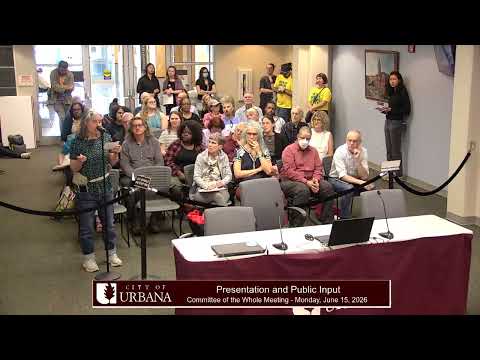
Urbana committee forwards contentious Civic Center landmark decision to City Council after heated debate over downtown transit hub
Summary
After more than three hours of public comment and council debate, the committee moved a local-landmark ordinance for 108 E. Water St. to the full City Council without a recommendation. Preservationists cited the building's mid-century significance; transit officials warned landmarking would likely derail a $32 million federal grant opportunity for a downtown transfer center.
The Committee of the Whole voted on Monday to forward a local-landmark ordinance for the Urbana Civic Center (108 East Water Street) to the full City Council without a committee recommendation, after lengthy public testimony and an extended debate over whether landmark status would kill a proposed downtown bus transfer hub.
The Historic Preservation Commission concluded the civic center meets multiple local landmark criteria, citing architectural significance and the building’s long role as a civic gathering place. Staff noted the Illinois State Historic Preservation Office and federal reviewers have already found the structure eligible for the National Register of Historic Places, triggering a Section 106 review under the National Historic Preservation Act.
That technical finding set up a clash between preservation advocates, who argued adaptive reuse is feasible, and transit officials, who said landmarking would undermine a pending federal grant. A memo read into the record from Carl Gennat, managing director of the Champaign‑Urbana Mass Transit District (MTD), said the district would decline to pursue a federal buses-and-bus-facilities grant for a downtown transfer center "for projects that depend on conditions outside its control" if local designation prevented implementation. Council members and speakers repeatedly summarized that as: landmarking the building would likely end the current $25.6 million federal grant opportunity that requires a $6.4 million local match (about $32 million total).
Preservation supporters urged collaboration. David Hayes, vice chair of the Historic Preservation Commission, told the committee the commission and MTD staff have described "adaptive reuse is a very wide range" and urged more time for joint design work that could preserve significant elements while accommodating bus circulation and accessibility. Historic‑commission members and neighborhood supporters repeatedly emphasized that local designation does not automatically prohibit reuse and that certificate-of-appropriateness processes exist to evaluate changes.
Opponents of landmark status framed the decision as urgent for transit riders. Annie Adams, chair of the Urbana Bicycle Pedestrian Advisory Commission, said a downtown transfer center would provide shelter, ADA accessibility and modern facilities for thousands of riders who currently wait outdoors and that landmarking the civic center would likely stop MTD’s grant application and the project in Urbana.
After the public record closed, Council Member Woo moved — and Council Member Grace seconded — to forward the local‑landmark ordinance to the City Council for final action, with no recommendation from the committee. The motion passed; the ordinance is scheduled for the City Council regular meeting for final action under the timeline set by the zoning code.
What happens next: The zoning ordinance requires final designation (or denial) to be decided by the full City Council. The committee action preserves both options for councilors — to adopt the local‑landmark designation and require certificates of appropriateness for future changes, or to decline designation and allow demolition and redevelopment plans to proceed. MTD and preservation representatives said they will continue informal discussions; both sides urged the City Council and staff to pursue direct, timely coordination if a compromise is possible.