Get Full Government Meeting Transcripts, Videos, & Alerts Forever!
Get email alerts on the Montana Tapestry Exhibit topic
No spam. Unsubscribe anytime.
Montana 250 vice chair unveils "Montana Tapestry" exhibit, spotlights eight Montanans
Summary
Molly Stockdale, vice chair of the Montana 250th Commission, described the Montana Tapestry exhibit, the commission's theme 'matakawasan,' and eight featured Montanans; the heritage banners will be on display at Fort Missoula and the Missoula Public Library beginning July 10.
Molly Stockdale, vice chair of the Montana 250th Commission and executive director of Travelers Rest Connection, presented the Montana Tapestry exhibit and explained how the project frames Montana’s role in the United States’ semiquincentennial.
Stockdale said the commission — created by the 2023 Montana Legislature to coordinate statewide semiquincentennial activities — adopted the Dakota phrase "matakawasan," which she said translates roughly to "all my relations," as the exhibit’s guiding theme to emphasize connections across communities. "We wanted to really put the focus on the fact that Montana is far away from those original 13 colonies, but we are just as an important part of the United States of America," Stockdale said.
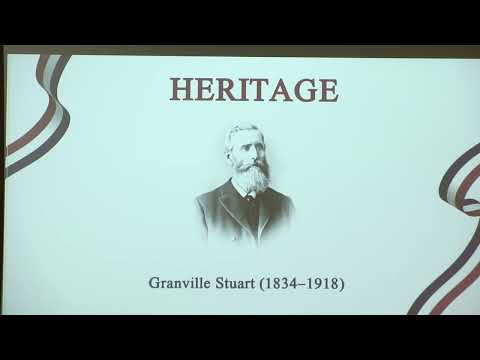
The exhibit includes a set of "people banners" that highlight eight Montanans in four categories: heritage, innovation, inspiration and service. Stockdale reviewed the biographies on the banners and the archival materials that support them. She presented Granville Stewart as an early territorial figure known locally as "Mr. Montana," describing his mercantile and ranching career, service in the state legislature and later archival legacy; she also noted historical reports of violent vigilante activity associated with a group called "Stewart's stranglers." Stockdale said the banners include QR codes linking to fuller biographies on the Montana Historical Society website.
On the heritage banner for Pretty Shield, a Crow medicine woman, Stockdale quoted a translated passage recorded by anthropologist Frank Linderman that reflected Pretty Shield's memories of the buffalo herds and the cultural losses that followed the slaughter of the animals. Stockdale framed that record as an early indigenous perspective the commission wanted to preserve and make visible.
In the innovation category, Stockdale described Maurice Ralph Hillman of Miles City as a pioneering microbiologist whose team developed multiple vaccines and who moved quickly in 1957 to develop a vaccine during an avian flu scare. She also reviewed Caroline McIll's career as a pathologist, public-health advocate and one of the founders of the Museum of the Rockies.
Stockdale named Ivan Doig and actress-producer Lily Gladstone in the inspiration category, noting Doig's literary ties to Montana and Gladstone's visibility in contemporary film and television as an example of representation for younger indigenous audiences. In the service category she highlighted Gilbert Horn Sr., an Assiniboine WWII code talker and Merrill's Marauder who later helped lead Fort Belknap tribal governance and local services, and Elma Smith Jacobs, a librarian who helped lead construction of the Great Falls Public Library and later served as Montana State Librarian.
Stockdale said the commission also produced a companion set of "Montana in 1776" banners for state park visitor centers and that staff consulted with tribes in each area about language and imagery used on those panels. She noted that some banners include tribal beadwork and other locally created art.
The five heritage banners will appear first at the Fort Missoula Historic Museum and then be on display at the Missoula Public Library beginning July 10, Stockdale said. She invited attendees to scan QR codes on the banners and to visit montana250 (america250mt.org) for further information.