Get Full Government Meeting Transcripts, Videos, & Alerts Forever!
Get email alerts on the Surveillance And Privacy topic
No spam. Unsubscribe anytime.
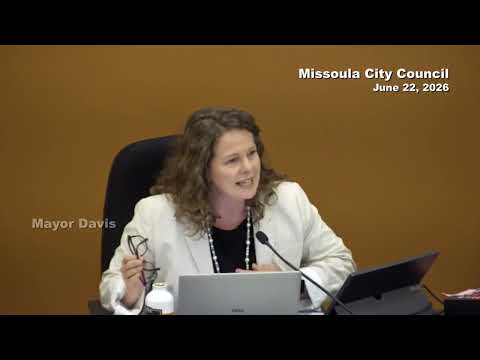
Cameras and privacy: Missoula council sends parks security‑camera plan back to committee after public uproar
Summary
After hours of technical Q&A and more than two hours of public comment raising privacy, procurement and vendor‑security concerns, the City Council voted 8–3 to send a proposed $366,000 parks camera upgrade and contract back to committee and requested a citywide facility‑security policy and explicit council approval before enabling automated facial or license‑plate recognition.
The Missoula City Council on June 22 voted 8–3 to send back to committee a proposed life‑cycle replacement and upgrade of security cameras at four parks facilities after extensive questions from council and prolonged public comment about vendor history, cloud storage and automated analysis features.
Parks Director Marina Yoshioka described the narrowly scoped proposal as a replacement of aging cameras at Currents Aquatic Center, Fort Missoula Regional Park, Splash Montana and Moash Skate Park and requested added parking-lot coverage. Yoshioka said the department has used cameras since 2006, does not proactively monitor footage, limits access to a few designated staff and typically retains footage for 30 days unless an incident requires longer retention. She told council the upgrade would restore usable footage to investigate vandalism, theft and assaults described in incident histories.
Eric Holstrom, the city’s chief operating officer, described a procurement approach that relied on established purchasing alliances and a preferred vendor stack; he said the city would own and control the footage and that the vendor (recorded in meeting materials as the Ricotta/Vicata provider) would have no access unless specifically granted. Holstrom briefed the council on encryption, audit logs and the vendor’s recent federal enforcement settlement (FTC/DOJ) and explained steps the vendor took to change its encryption-key management after that action.
Councilors asked detailed technical and governance questions: how a cloud-license model differs from a city‑hosted DVR, who controls toggles for optional software features (for example, automated facial recognition or license‑plate reading), what alerts or audit trails would show if a restricted feature were activated, and what the city’s long‑term subscription and maintenance costs would be. IT Director Jesse Naidk and Holstrom explained the vendor offers an integrated cloud service with role-based administration, and that administrative toggles for advanced analytic features should be limited to a small number of city administrators and remain auditable.
A lengthy public-comment period followed. More than a dozen residents, technology professionals, civil‑liberties representatives and victims’‑rights advocates presented concerns and, in many cases, urged rejection or further review. Several speakers cited a 2021 security incident and later FTC/DOJ enforcement records involving the vendor and urged rebidding or a city‑hosted alternative; others asked for firmer guarantees that automated recognition tools would be contractually and technically disabled. The ACLU of Montana offered to help craft a model policy.
Council President Nent said she would seek an amendment to bar automated facial recognition and automated license‑plate readers for parks cameras without specific council approval and asked administration to develop a citywide facility‑security policy published publicly. Councilor Campbell moved to send the contract and budget amendment back to committee for further work; the motion passed 8–3.
What’s next: the items will be discussed in committee with staff, legal counsel and community stakeholders. Council directed staff to return with a recommended policy that limits analytics features, spells out access controls and auditability, and explains vendor selection and encryption safeguards.