Get Full Government Meeting Transcripts, Videos, & Alerts Forever!
Get email alerts on the Parks And Recreation topic
No spam. Unsubscribe anytime.
Gage Park board reports stable revenue, details projects and funds study of West Lake embankment
Summary
James Martin, the county’s appointee to the Gage Park Improvement Authority, told commissioners that sales-tax receipts have produced a stable revenue stream and that the authority is using its 5% share to build reserves, fund projects (shelter-house design, message board, fiber loop) and pay for a drainage study focusing on West Lake’s embankment.
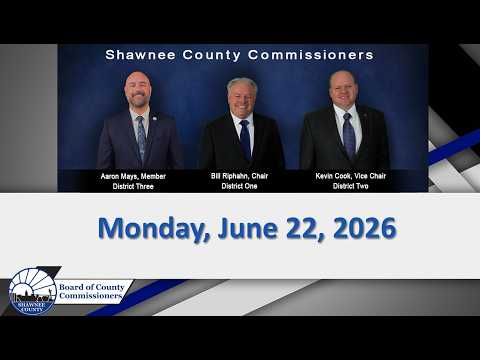
James Martin, an appointed representative of the Gage Park Improvement Authority, told the Shawnee County Board of Commissioners on June 22 that the authority’s finances are stable and that it is moving from start-up oversight into active project work. "We do have a very, very stable revenue source," Martin said, adding the sales-tax proceeds have produced roughly $8 million to $9 million a year for the park entities and that the authority’s 5% share yields about "$35 to $38,000 a month."
Martin summarized the authority’s role: to receive monthly distributions from the Kansas Department of Revenue and direct funds to the zoo, Shawnee County, and the Kansas Children’s Discovery Center under the statutory split. He said the 5% set aside for the authority is restricted to park-related expenses and projects.
The authority has formalized financial controls, Martin said: an accounting firm now executes monthly transfers and presents monthly financial reports, a three-member financial subcommittee vets requests, and the authority obtains annual independent financial reviews. Martin said those steps were intended to preserve institutional knowledge as appointed board seats turn over.
Martin walked commissioners through items on the authority’s project list. The board has contributed more than $100,000 to master planning with a park-focused component and provided $150,000 toward design of a larger shelter house the zoo requested. The authority also helped fund a fiber-optic loop intended to serve the central park facilities and recently provided $110,000 toward a new electronic message board to publicize park events.
Martin highlighted investments in smaller but essential work the authority can influence: closed-circuit TV inspections of sanitary and storm sewers to identify repair needs, contributions to improvements at the Gage Park war memorial, and subsidies for free or reduced admissions in partnership with the Discovery Center, zoo and Topeka Library. "All the funds go to the park," he said.
A major near-term focus is a drainage study covering the West Lake basin and the embankment (described in the update as a dam). Martin said the Discovery Center declined to participate in the larger park-wide drainage project, so the study presently concentrates on West Lake and adjacent basins that affect the band shell, pool and carousel areas. He cautioned that the authority was funding the study and not the full construction cost of any large remediation. Martin offered a preliminary range for potential repairs of about "$750,000 to $1.5 million," but said final design and costs will come from the study.
Commissioners pressed on technical details and safety implications. Martin said engineers do not believe the embankment presents an imminent hazard, but they have observed long-term seepage and the embankment was not constructed as a modern engineered dam. He said options under consideration include partial drawdown, dredging and other foundation treatments; a slurry wall would not work given rubble inside the embankment. He pledged to return with more detailed answers as the study produces recommendations.
Martin offered the annual report for commissioners to review and said the authority intends to keep recipients accountable to complete projects tied to committed funds. "We've been able to shepherd and use the money that we're getting as a board very effectively," he said.
What happens next: the authority will complete the drainage study, produce cost estimates and recommendations, and report back to the board. Commissioners did not take any formal action on projects during the session; the authority’s next steps will depend on the study’s findings and the availability of funds or partner contributions.