Get Full Government Meeting Transcripts, Videos, & Alerts Forever!
Get email alerts on the Operating Referendum topic
No spam. Unsubscribe anytime.
Franklin Community School Corp. board approves resolution to seek 29‑cent operating referendum for November ballot
Summary
The Franklin Community School Corp. board approved a resolution and revenue‑spending plan to place a 29‑cent operating referendum (maximum $9 million annually) on the November 2026 ballot; counsel said legal steps must be completed by about July 31 for certification.
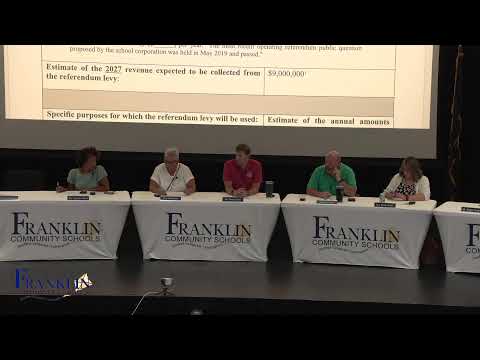
The Franklin Community School Corp. Board of Trustees voted to approve a resolution and revenue‑spending plan that will place a proposed operating referendum on the November 2026 ballot. The resolution, approved by a voice vote during the June 23 meeting, would ask voters to permit a tax rate not to exceed 29 cents per $100 of assessed value and a maximum annual levy of $9 million if certified by county and state officials.
Dr. Glenn Denning, speaking at the start of the discussion, framed the referendum as a community partnership to sustain teacher and staff pay, safety initiatives and academic programs. "We're here to kind of look at an opportunity that we have before us and offering the community a chance to partner with us for an operation referendum in November," he said, and reviewed the district's fiscal history and outcomes since the 2019 referendum.
Trey House, the district's chief financial officer, presented charts and modeling showing historical tax‑rate trends and projected cash flows. House said a 29‑cent rate would better stabilize revenues through 2034 than letting the current referendum expire in 2027 or renewing only at the prior 23‑cent level, calling 29 cents a "middle ground" given changes in state law and revenue assumptions. He and administration staff said consultants including Baker Tilly and policy analysts assisted with the projections.
Eric Long of Ice Miller, who serves as bond counsel for the district, explained the procedural steps to get the question on the ballot: the board must first pass a resolution and the revenue spending plan, obtain county auditor certifications for figures that remain blank in the draft ballot language, and then have the ballot question reviewed by the Indiana Department of Government Finance (DGF). "In order to get on the ballot in November of 2026, all of the school corporation's legal steps have to be wrapped up by effectively July 31st," Long said.
The revenue‑spending plan included three priority categories and proposed percentage allocations: 50% for retaining teachers and support staff, 25% for essential student health and safety initiatives (the administration cited athletic training services as an example), and 25% for maintaining class sizes and academic programming. Administration emphasized that the board must submit maximum rate and levy figures but retains ability in later budgets to collect less than the maximum.
A board member asked whether tax‑increment financing (TIF) districts affect the district's ability to capture assessed‑value increases. Long replied that absent a referendum increases inside a TIF are not available for school operations, but operating referenda allow the increased assessed value to be used in the referendum computation.
The board approved the resolution and revenue‑spending plan by voice vote; the transcript records three affirmations of "I." The motion had been moved and seconded before the voice vote. The administration will work with the county auditor to fill the blank figures in the ballot question and certify the question to the DGF by the July deadline.
Next steps: if the board's certified question clears the county auditor and the DGF, the referendum question will appear on the November 2026 ballot for Franklin Community School Corp. voters. The board did not record a roll‑call vote in the transcript; the approval was by voice vote during the meeting.