Get Full Government Meeting Transcripts, Videos, & Alerts Forever!
Get email alerts on the Historic Preservation topic
No spam. Unsubscribe anytime.
Urbana council declines to designate Civic Center a local landmark after contested hearing
Summary
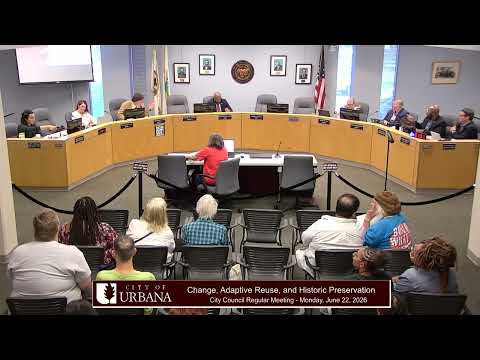
After hours of testimony from preservationists, architects and the Champaign-Urbana Mass Transit District, Urbana City Council voted down an ordinance to make the long-vacant Civic Center a local landmark, with members split over preservation and the feasibility of a downtown transit center.
Urbana City Council on Monday voted against designating the Urbana Civic Center at 108 East Water Street as a local historic landmark, rejecting Ordinance 2026-06-016 after lengthy presentations and public comment.
The council’s 4–2 roll call (Yes: Evans, Wilkin; No: Wu, Hersey, Jones, Quisenberry) followed competing testimony about whether landmark status would protect an architecturally significant modernist building or block development of a $32 million Mass Transit District (MTD) downtown transfer center.
The Historic Preservation Commission and preservation advocates argued the Civic Center meets local landmark criteria and urged the council to preserve the building’s character while exploring adaptive-reuse options. “I remain incredibly concerned about misinformation and missed opportunities for communication,” Kate Holiday, a member of the Historic Preservation Commission, told the council during the presentation phase. Holiday said the commission was not meaningfully included in the Section 106 federal review and that the commission would be willing to draft collaborative language about rehabilitation strategies.
Architect and professor Joseph Altshuler, introduced by council, showed diagrams and site analysis suggesting partial demolition, encapsulation or bridging strategies could retain the Civic Center’s distinctive elements while accommodating a larger transit facility. Altshuler gave site figures used in his analysis: a roughly 82,000-square-foot site and an existing civic center footprint of about 8,394 square feet, and said reuse and transit goals are not mutually exclusive: “We can have both.”
MTD’s managing director, Carl Gannett, said the district’s operational requirements — off-street transferring, layover parking for mixed fleets that include 60-foot articulated buses, and circulation space — are constrained by the Civic Center’s location and form. “We want to have a facility that is off-street transferring, which improves accessibility and safety,” Gannett said. He added that consultants engaged to advise the NEPA and Section 106 review had concluded the existing building footprint complicates circulation and capacity needs and that landmark status would make the project “very challenging” to accomplish on the site.
Public comment reflected the split in the community. Preservation groups and architectural historians urged council to accept the Historic Preservation Commission’s recommendation; Susan Apple of PACA noted the commission found the building met five of seven local significance criteria. Disability-rights and transit advocates, students and many regular MTD riders argued that a downtown transfer center would greatly improve accessibility and safety. “We ask that you vote no on the landmark designation for the Urbana Civic Center,” Anna Howe of the Curbanism Club said, urging the city to prioritize a functioning transit hub.
Council members framed the decision around two competing priorities: a city-owned property that meets local landmark eligibility and the potential to secure federal and state transit funding and a consolidated downtown transfer facility. Several members warned that a landmark designation would likely restart or extend federal environmental review processes. Council member Mary Alice said she was not convinced that the Civic Center could not be partially preserved while allowing a new transit facility, but she said the current political and trust landscape made collaboration uncertain. Council member James (Wilkin) cited practical constraints and said he would not support the landmark designation without clearer assurances the transit project could proceed if needed.
The ordinance to designate the building as a local landmark failed on the floor. The council took no final formal action that would stop MTD from pursuing the site through other city processes; council members noted that transfer of city property to MTD would still require an intergovernmental agreement and further council approvals.
What’s next: Council members and staff said the city will continue to engage affected parties. Several council members said they would not move forward with demolition unless MTD’s grant and project timeline were secured, and some suggested revisiting preservation or reuse options if a grant does not materialize. The council also approved other business that night, including a special-use permit and the FY2026–27 budget.
(Quotes are drawn from council meeting testimony and public comment on June 22, 2026.)