Get Full Government Meeting Transcripts, Videos, & Alerts Forever!
Get email alerts on the Infrastructure topic
No spam. Unsubscribe anytime.
Commission ratifies Salisbury Street culvert changes after field discoveries; members flag knotweed stockpile concerns
Summary
After on-site pre-construction work revealed sloped headwalls and greater dewatering needs, the commission authorized field-driven changes for the Salisbury Street culvert replacement but discussed risks from stockpiling soil containing Japanese knotweed and asked for restoration and removal plans.
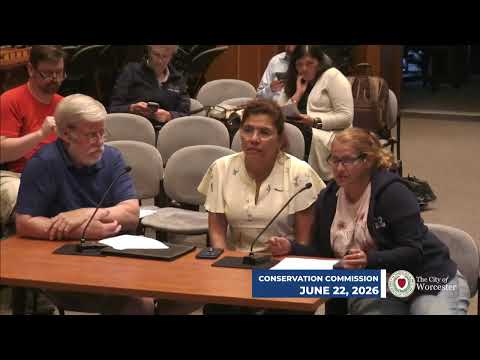
The Worcester Conservation Commission on June 22 authorized project-change revisions for the Salisbury Street culvert replacement after engineers reported in-field differences from the bid plans and a need to expand temporary dewatering controls.
Greg Rousseau of Weston & Sampson explained that headwalls at the private dam near the culvert slope outward, increasing the potential area that must be dewatered to allow safe construction. The design-team options presented included installing additional sandbags or driven plates in an arc configuration, adjusting the bypass-pipe angle to avoid interference with a new downstream headwall, or using pumps with filter bags if the bypass cannot be installed as planned.
Rousseau said the changes were discussed with the city’s monitoring staff and administratively approved to allow work to proceed, but the commission reviewed and ratified the change request so members could ask questions and record conditions.
Commission discussion focused on temporary buffer impacts and a practical difficulty: excavation removed stands of Japanese knotweed in the replacement area and the contractor had temporarily stockpiled knotweed‑infested soil in a cordoned-off area that is already dominated by the invasive plant. Commissioners asked whether the knotweed material would be removed at project completion and whether restoration measures would be employed. Rousseau and the team said disturbed areas would be seeded with a stabilization or roadside mix and that excavated material stored in an area already dominated by knotweed would be removed at the end of the project where feasible.
The commission voted to authorize the field-driven changes and directed staff to document the temporary measures and confirm final site restoration and removal of invasive-material stockpiles as part of permit closeout.