Get Full Government Meeting Transcripts, Videos, & Alerts Forever!
Get email alerts on the Land Use Zoning topic
No spam. Unsubscribe anytime.
Planning commission backs rezoning, PUD and conditional-use permit for 480-acre Ryan Companies proposal amid resident objections
Summary
The Pine Island planning commission recommended approval of a rezoning to light industrial, a planned-unit development (PUD) final plan and a conditional-use permit for a 480-acre Ryan Companies proposal that could allow data-center uses. Residents raised concerns about noise, energy use and environmental impacts; the commission attached conditions and forwarded recommendations to city council.
The Pine Island Planning and Zoning Commission on Monday recommended approval of a rezoning to light-industrial (I2), a planned-unit development final plan and a conditional-use permit for a roughly 480-acre proposal from Ryan Companies, despite multiple resident objections about noise, power demand and environmental risk.
Stephen, a city staff member, told the commission the land was petitioned for annexation by the developer and that newly annexed acreage defaults to agricultural until rezoned. He said the application seeks I2 zoning for the property and that Minnesota Statute 1599 sets a 60-day timeline that prompted review by the commission this month. He said the city’s comprehensive plan and prior maps have designated the area for future industrial use.
Residents who signed up to speak urged the commission to pause, reclassify data centers as heavy industrial or use stricter conditional controls. “Hyperscale data centers are not light industrial,” said Rodney Lanners, arguing such facilities require “massive power needs, large-scale cooling, extensive generators and … substantial environmental issues and residential incompatibility.” Lauren Simpson told the commission she wanted a moratorium and said data centers operate 24/7, can reach millions of square feet and draw power on the scale of large cities; she urged the code to continue excluding data centers from light-industrial uses.
Reverend David Dirkson and other commenters pressed the commission to follow packet criteria and insisted that, where high-voltage transmission or other heavy uses are involved, the city should apply conditional approval rather than treating the proposal as ordinary light industrial.
Staff and the city engineer answered technical questions during the meeting. They said the developer’s current design proposes a closed-loop, air-cooled system (not a water-cooled plant) and that first-phase domestic/maintenance water use is estimated at about 20,000–23,000 gallons per day. Staff said emissions and backup-generator permitting fall under state oversight and the Public Utilities Commission rather than the city, and that generator emissions would require MPCA (Minnesota Pollution Control Agency) permitting.
On noise, staff noted Minnesota law prevents the city from imposing local sound-pressure limits that are more stringent than MPCA guidance; the commission was told the PUD language uses MPCA-based limits (60 dB daytime, 50 dB nighttime) and that the developer removed a proposed exemption for emergency-power testing from the final plan. Staff recommended adding permit-time language so each building phase must comply with whatever MPCA standards are in effect when that building permit is issued.
Engineers said the stormwater management plan was submitted as a large supplemental document and that the plan as filed complies with MPCA rate-and-quality requirements; MDOT is reviewing right-of-way and access across Highway 52. Staff emphasized that approving the proposed PUD overlay gives the city site-specific controls (phasing, conditions and limits on expansion) that a straightforward code change would not provide.
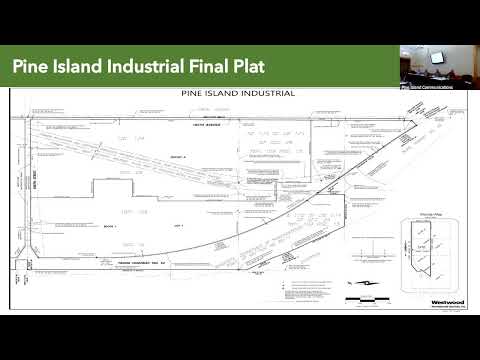
Votes at a glance: the commission took voice votes to (1) recommend rezoning the annexed property to I2 (voice vote; counts not specified), (2) recommend approval of the conditional-use permit together with the final development plan for the PUD (voice vote; counts not specified), and (3) approve the final plat subject to 12 technical conditions outlined by staff (voice vote; counts not specified). City staff said the city council is expected to consider the recommendations at its meeting next week.
The 12 conditions on the final plat include required signature blocks and title assurances, final stormwater easements and documentation, submittal of final construction and grading plans, any required MDOT permits for access on Highway 52, addressing referral-agency comments and executing a development agreement with the city before recordation.
Commissioners and staff repeatedly told speakers that many technical and regulatory items — generator emissions, large-scale power connections and certain environmental permits — are regulated at the state level and require separate permit reviews outside the city’s land-use process. Staff also said an environmental document was submitted to referral agencies and the state Environmental Quality Board for review and comment.
The recommendation forwards the rezoning, PUD final plan and CUP to the city council; the council will have final authority on ordinances and permit approvals. Residents who urged a pause said they will continue asking for stricter limitations on noise, backup-generation testing and energy impacts. The commission’s action leaves detailed engineering reviews, state permitting and any subsequent building-permit checks as the next steps if council concurs.